
 Website Designing
 Web Development
 Mobile Applications
 Marketing
 CMS & Ecommerce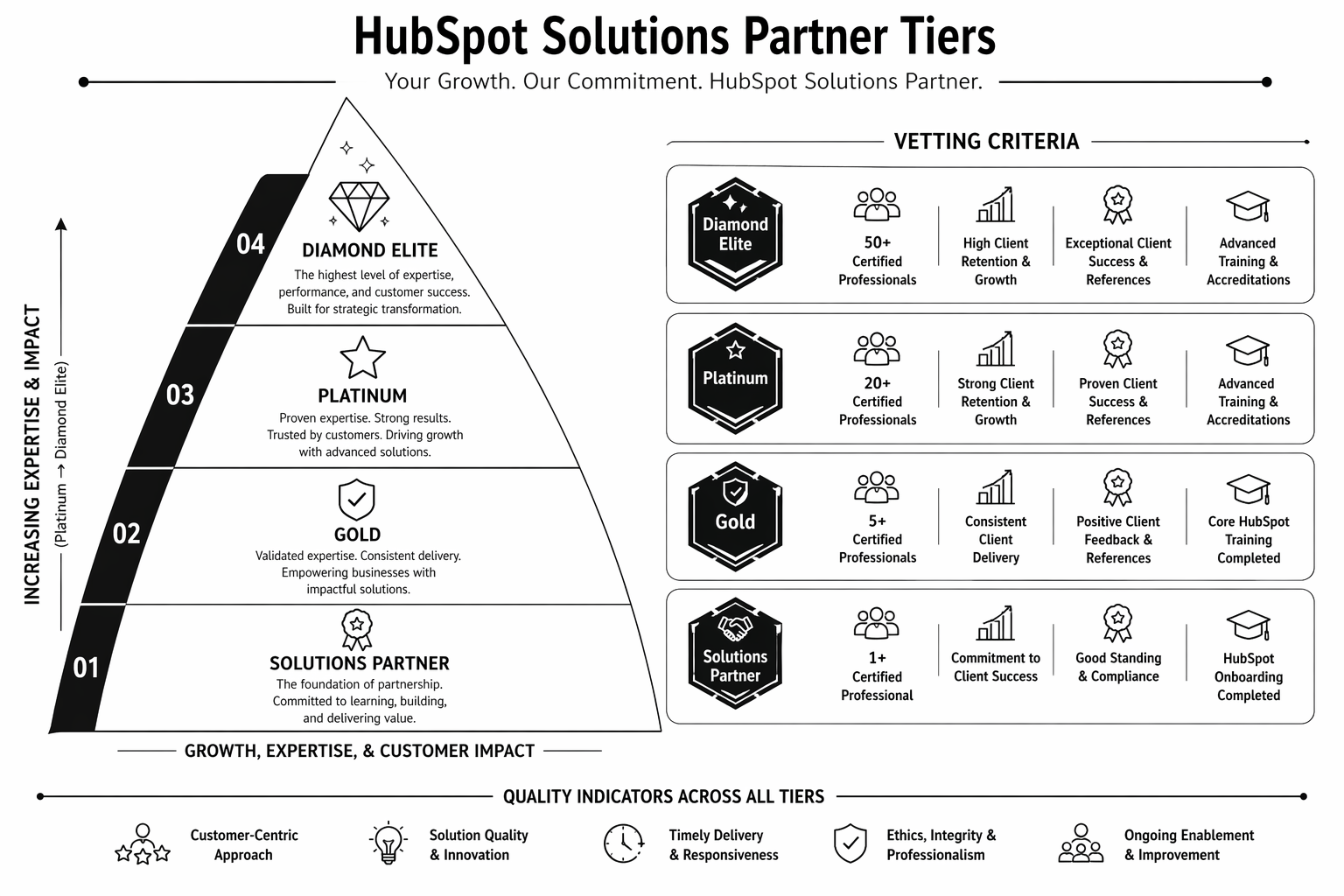
Table of Contents
Almost every HubSpot implementation fails because the team chose the wrong partner. Not because HubSpot is complex, but because 80% of certified HubSpot agencies treat certification as a marketing badge, not a practice discipline.
This guide covers HubSpot tier levels, red flags that expose weak partners, questions that separate tier-one implementers from tier-four problem shops, and how to evaluate proposals objectively. Written for RevOps heads, marketing leaders, and founders planning a HubSpot build or migration.
HubSpot Solutions Partner Tiers Explained
HubSpot’s official partner tier system:
- Gold — Entry-level certification. Usually 1–5 people. Good for very basic implementations, single-module help.
- Platinum — Mid-market focused. Typically 5–20 people. Strong for website builds, CMS work, most marketing automations.
- Diamond — Enterprise focus. 20+ people. Strong across entire HubSpot stack. Premium pricing but capability justifies it.
- Elite — Rare. Less than 20 worldwide. Top-tier implementation, training, custom development. £200k+ minimum projects.
Most teams should target Platinum partners for website/CMS work, Diamond if you have complex RevOps requirements.
Red Flags That Expose Weak Partners
- Gold tier pitching for £80k+ projects. They lack the bench and depth. They’ll hire junior people or outsource, then you’ll carry the quality risk.
- Portfolio showing only template setups. Not real builds. Agencies with depth have case studies, not screenshots.
- Website mentions HubSpot once and nothing else. If HubSpot is not a major pillar of their practice, it’s not their focus.
- Salesforce or Pipedrive expertise listed equally with HubSpot. CRM platforms are different. A generalist is not specialized.
- Quoting a fixed timeline with no discovery phase. “12 weeks for your HubSpot migration” assumes they understand your scope. They don’t. Red flag.
- No retainer support mentioned. HubSpot builds require ongoing care. Agencies that don’t offer retainers are implying “set and forget” is possible. It’s not.
- “We build on Zapier/integromat instead of native workflows.” Third-party automation layers add cost, fragility, and vendor lock-in. Native workflows are the right pattern.
Questions That Expose Misalignment
“Walk us through your most complex HubSpot CMS Hub build. What was the CMS structure? How did you architect HubDB?” — Weak partners give generic answers. Strong partners have detailed opinions.
“Tell us about a HubSpot project that went wrong. What happened and how did you fix it?” — Experience surfaces here. “Everything goes smoothly” is a lie.
“What’s your approach to property mapping and data hygiene in HubSpot?” — Properties are the foundation. Sloppy mapping breaks everything downstream. Strong partners have a documented approach.
“Show us your retainer model. What’s included? What’s not? How do you prioritise requests?” — Good agencies have clarity. Bad ones make it up as they go.
“What’s your process for running smart content tests or multivariate experiments on HubSpot sites?” — HubSpot CMS has native A/B testing. If the agency doesn’t mention it or doesn’t use it, they’re treating CMS Hub like WordPress.
“Have you migrated from WordPress/Webflow to HubSpot? What was the URL strategy? How did you preserve SEO?” — Migration experience is a differentiator.
Pricing and Engagement Structures
Typical HubSpot website builds:
- Small site (5–10 pages, basic CMS): £15k–30k
- Growth-stage site (15–30 pages, HubDB, smart content): £40k–80k
- Enterprise (30+ pages, complex RevOps, integrations): £80k–200k+
Retainers after launch: £1.5k–5k/month depending on scope, team size, and update velocity.
Red flags:
- Project quotes without discovery phase built in.
- Retainers below £1k/month (indicates minimal support).
- Fixed-price with no change request process.
- “Time-and-materials with no cap” (budget risk on your side).
Vetting Process: How to Actually Evaluate Partners
Step 1: Portfolio review. 5–10 projects minimum. Case studies with metrics, not screenshots. References from similar company stage/size.
Step 2: Reference calls. Talk to 2–3 past clients. Ask: Did they deliver on time? Did the implementation improve your metrics? Would you hire them again?
Step 3: RFP with clear scope. Send a detailed brief: current state, desired state, team composition, timeline expectations. See who asks clarifying questions vs. who submits a quote immediately.
Step 4: Discovery call quality. Best agencies do a deep discovery. Watch for:
- Do they ask about your RevOps stack? Your CRM properties?
- Do they understand your buyer journey?
- Do they challenge your assumptions or just confirm them?
Step 5: Proposal evaluation. Look for:
- Detailed scope and deliverables.
- Phase breakdown with milestones.
- Team composition (who’s building? who’s managing?).
- Post-launch retainer included or separate?
- Clear SLAs for response time and support.
Evaluating HubSpot agencies and need a second opinion? Our HubSpot specialists can review proposals and advise on fit. Book an agency evaluation call.
After You’ve Hired: Protect Your Project
- Weekly syncs, not monthly. Catches issues early.
- Staged payments. 33% discovery/planning, 33% build, 33% launch + training.
- Design approval gate. You approve IA and designs before build starts. Changes after this point = scope creep.
- Retainer scope in writing. How many hours per month? What’s included? What’s not?
- Knowledge transfer. Before launch, the team should know how to run basic operations in HubSpot. Training is non-negotiable.
If you’re comparing platforms before choosing HubSpot, see HubSpot CMS vs WordPress to confirm fit first.
FAQ
Is a Platinum-tier partner enough for my HubSpot website?
For most B2B SaaS companies, yes. Diamond is premium if you have complex RevOps or enterprise needs, but Platinum delivers strong website and CMS builds.
What questions should I ask a HubSpot agency?
See the “Questions That Expose Misalignment” section above. Focus on specifics and past projects, not theoretical capability.
How do I know if a HubSpot agency is overcharging?
Compare proposals from 2–3 similar-tier agencies. If one quote is 2x+ higher with the same scope, ask why. Could be more experienced, could be padding.
Should I hire an agency or do HubSpot in-house?
If you have strong in-house ops and CRM expertise, in-house works. For most teams, agency is faster and reduces risk. Hybrid works too: agency for build, in-house for ongoing ops.
What’s the difference between a HubSpot agency and a general web agency?
HubSpot agencies specialise in CRM-native architectures, property mapping, and lifecycle design. General web agencies treat HubSpot like a CMS. Different discipline entirely.
Conclusion: The Right Partner Pays for Itself
HubSpot implementations that fail usually fail because of partner choice, not platform choice. The right Platinum or Diamond partner reduces risk dramatically and often delivers ROI in the first quarter.
Spend extra time on vetting. The partner you choose determines your project’s outcome as much as the platform does.
Need help evaluating agencies or choosing a HubSpot partner? Our team can advise on fit. Book a consultation.
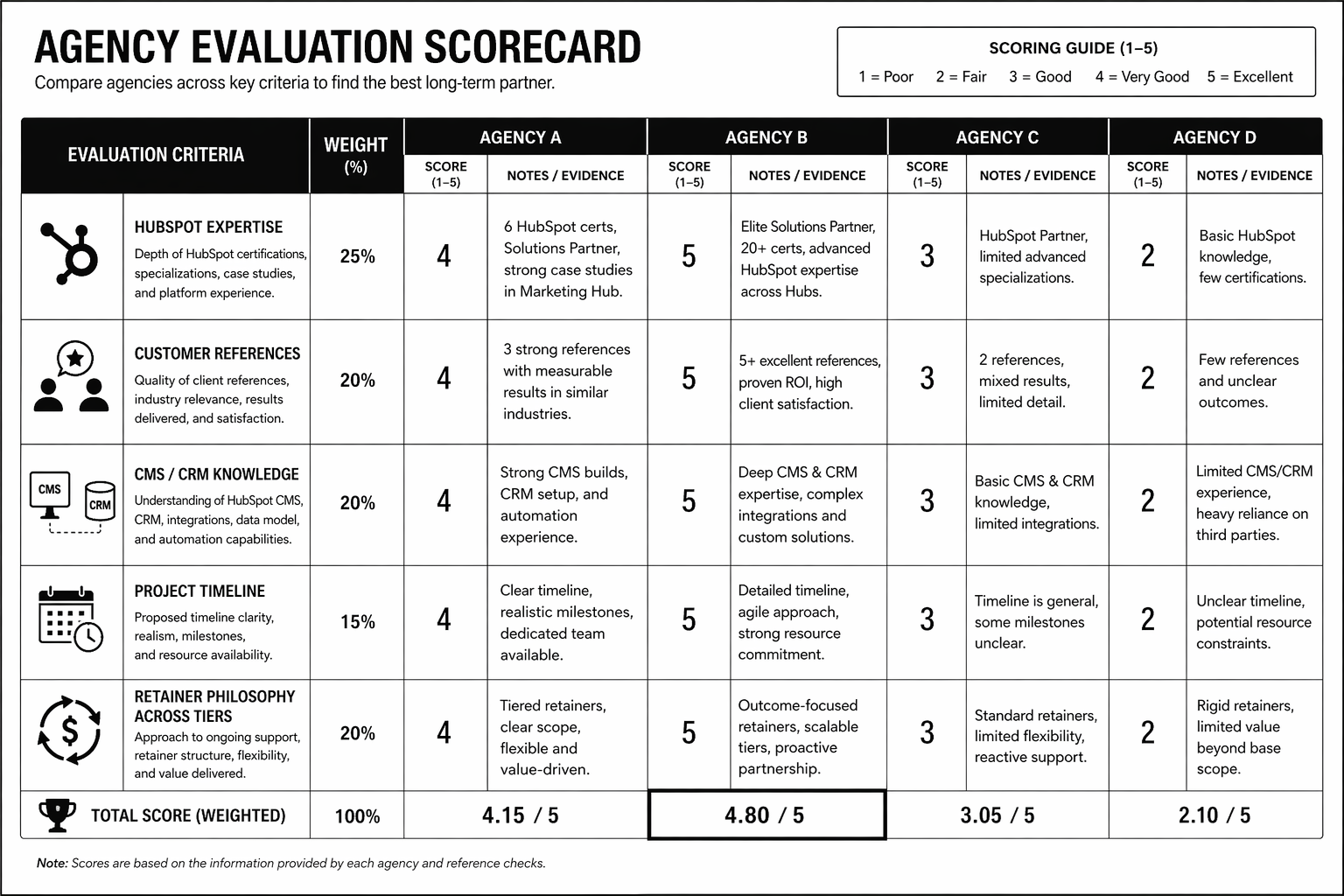
The HubSpot Agency Scorecard
— a detailed rubric to evaluate proposals and rank partner fit by Tier, capability, and cultural alignment.