
 Website Designing
 Web Development
 Mobile Applications
 Marketing
 CMS & Ecommerce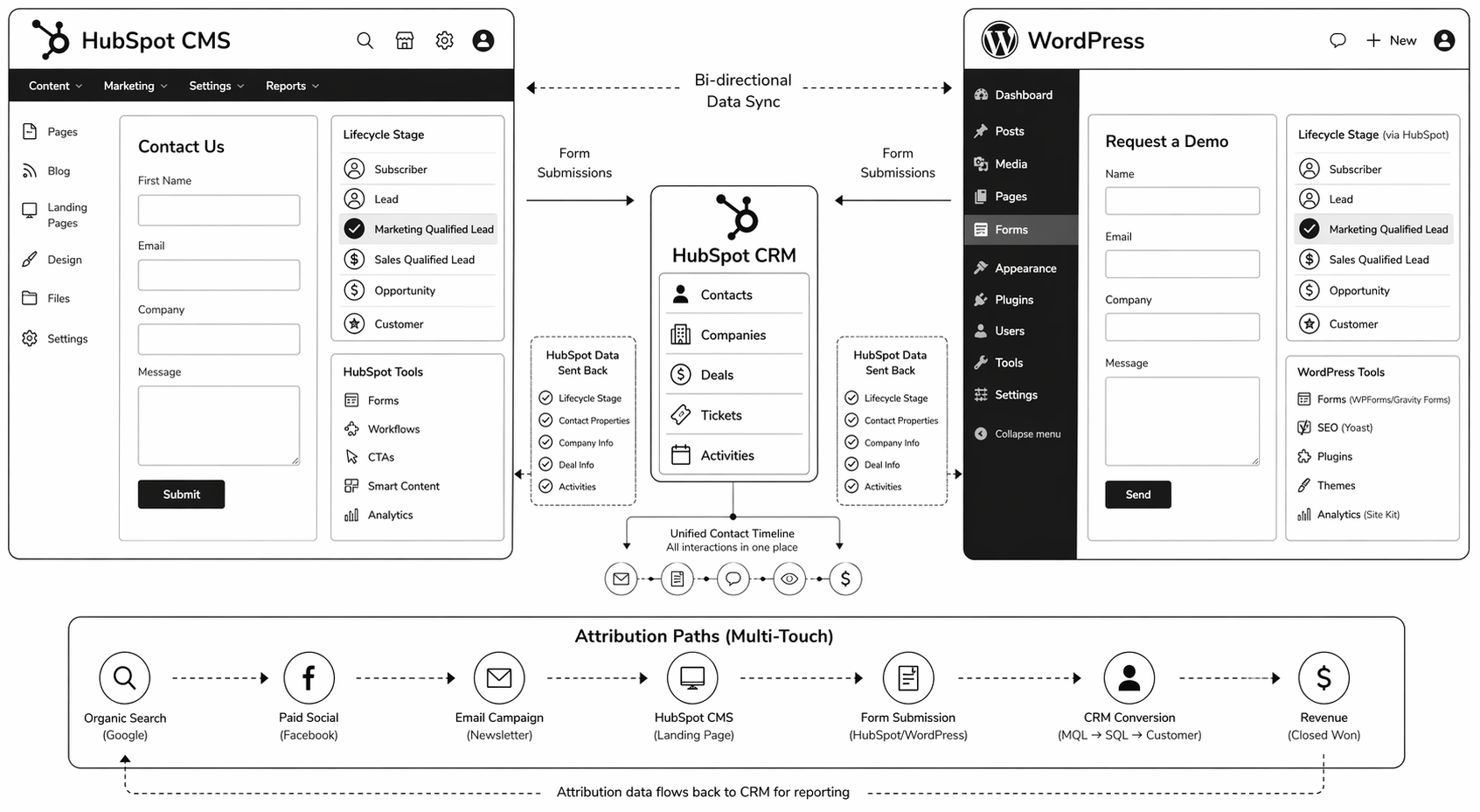
Table of Contents
The HubSpot CMS vs WordPress decision is one of the highest-leverage choices a B2B SaaS marketing team makes. It affects content velocity, CRM data quality, attribution confidence, and how quickly pipeline insights can turn into page-level changes.
Most comparisons treat this like a template battle. It is not. In 2026, this is a systems question: do you want a tightly integrated revenue platform, or a flexible CMS stack you can assemble yourself?
The Core Difference
WordPress is a highly extensible CMS that can connect to almost anything. HubSpot CMS is a CRM-native CMS designed to work as part of one growth system. WordPress gives freedom. HubSpot gives alignment.
- WordPress strength: ecosystem breadth and custom flexibility.
- HubSpot strength: lifecycle-aware content, native attribution, and cleaner operations.
- B2B SaaS reality: most teams need execution speed and data consistency more than endless plugin optionality.
Pricing and TCO: What You Actually Pay
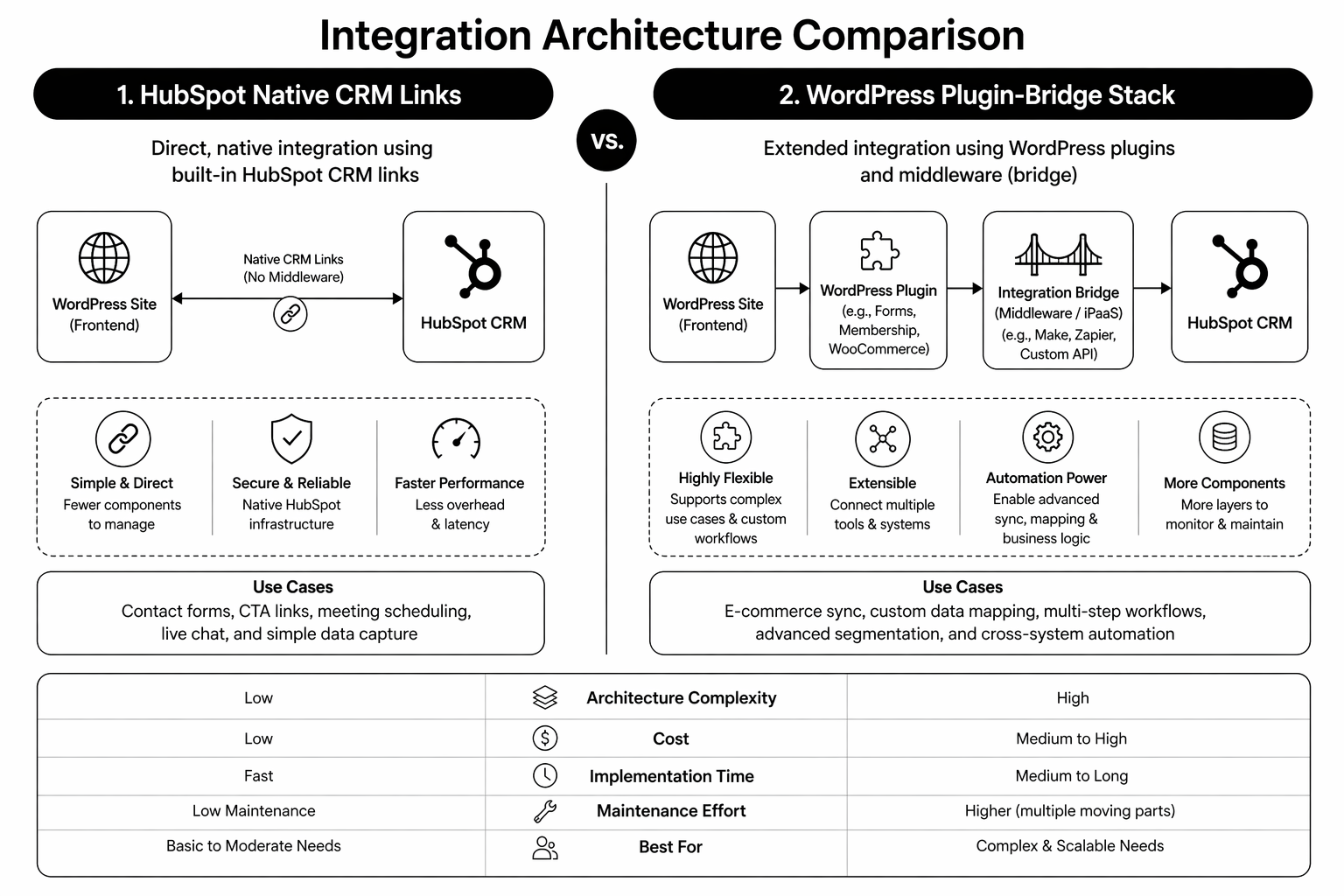
WordPress usually looks cheaper on paper: low hosting costs, open-source core, low-cost themes. But B2B SaaS teams often add premium plugins, analytics layers, form tools, ABM tooling, and maintenance retainers that increase total cost over time.
HubSpot CMS has a higher upfront platform cost but reduces tool sprawl and integration overhead if you are already inside HubSpot for CRM and marketing automation. The cost is concentrated, but execution is often cleaner.
If you need exact tier-level breakdowns, use our HubSpot CMS Hub pricing guide alongside this comparison.
Marketing and Sales Alignment
This is where HubSpot CMS vs WordPress becomes less debatable for many SaaS teams. HubSpot CMS is built for closed-loop operations. Form activity, page engagement, lifecycle updates, and campaign attribution live in one record.
WordPress can replicate this with integrations, but each additional connector adds failure points. If marketing and sales alignment is already fragile, a stack that needs constant integration maintenance usually makes it worse.
SEO and Content Performance
Both platforms can rank very well. WordPress has stronger plugin-level SEO tooling variety. HubSpot offers robust built-in SEO controls and cleaner operational consistency for content teams that do not want to manage plugin complexity.
If your team publishes a lot, consistency matters more than feature depth. A platform your team can use correctly every week tends to outperform a platform with more theoretical power.
When HubSpot CMS Is Usually Better
- You already use HubSpot CRM and Marketing Hub extensively.
- You need lifecycle-aware CTAs and smart content without custom engineering.
- You need clear attribution tied directly to contact and pipeline data.
- Your team wants fewer tools, fewer integrations, and faster execution cycles.
When WordPress Is Usually Better
- You require highly custom backend workflows and niche plugin logic.
- You have strong internal technical ownership for long-term maintenance.
- Your CRM strategy is not HubSpot-centric.
- You prefer stack flexibility over native system coherence.
Planning a CMS move this year? Our team maps migration scope, tracking continuity, and implementation risk before platform decisions are final. Book a HubSpot migration audit.
Migration Considerations
Moving from WordPress to HubSpot is usually less about design and more about data model decisions: URL structure, HubDB schema, form-to-property mapping, and attribution continuity. Teams that skip this prep often preserve page design while breaking pipeline reporting.
Use a structured checklist before any move. Our WordPress to HubSpot migration guide walks through the implementation order.
Also compare strategic overlap with Webflow vs WordPress if you’re deciding across multiple CMS options.
FAQ
Is HubSpot CMS better than WordPress for B2B SaaS?
For CRM-driven B2B SaaS teams, often yes. The native alignment between site, CRM, and attribution usually creates faster execution and cleaner reporting.
Is HubSpot CMS more expensive?
Upfront platform cost is higher. Total cost can be competitive when you account for plugin spend, integration maintenance, and operational drag in WordPress stacks.
Can WordPress match HubSpot functionality?
Technically yes, with the right plugins and integrations. The trade-off is complexity and ongoing maintenance overhead.
Should early-stage SaaS choose WordPress or HubSpot CMS?
If budget is tight and CRM complexity is low, WordPress can be fine. If the team is already committed to HubSpot and needs fast RevOps alignment, HubSpot CMS can be the better strategic choice earlier.
How long does WordPress to HubSpot migration take?
Most B2B SaaS migrations run 8 to 16 weeks depending on content volume, CRM schema complexity, and integration dependencies.
Conclusion: Choose Based on System Fit, Not Feature Lists
The right answer in HubSpot CMS vs WordPress is the platform your team can run as a repeatable growth system. For many B2B SaaS companies in 2026, that means HubSpot CMS because CRM and content are already inseparable. For others, WordPress remains the right fit where flexibility is genuinely required.
If your decision criteria are still fuzzy, start with pipeline requirements first, then pick the CMS that supports them with the least operational friction.
Need an external view before migrating? Our HubSpot development specialists can map platform fit and implementation risk. Book your audit.
The HubSpot vs WordPress TCO Calculator
— a practical worksheet to model software, maintenance, and team-time cost over 36 months.