
 Website Designing
 Web Development
 Mobile Applications
 Marketing
 CMS & Ecommerce
Table of Contents
Every LinkedIn post says AI is going to replace your ops team. Meanwhile, most businesses still can’t get a chatbot to hand a lead to sales without breaking. The gap between the hype and the shipping reality is enormous — and it’s exactly where the opportunity sits for companies that get AI automation right.
This guide is for operators: founders, COOs, heads of ops, marketing leaders. It’s an honest 2026 take on AI automation for business — what it actually delivers, where it fails, the workflows that return ROI inside a quarter, and how to build an implementation plan that doesn’t turn into a year-long science project.
What AI Automation for Business Actually Is
AI automation is the layer between traditional workflow automation (Zapier, Make, n8n) and autonomous AI agents. It’s automation where one or more steps uses a language model to do something a hard-coded rule can’t — understand context, extract structured data from messy inputs, write, summarise, classify, or decide.
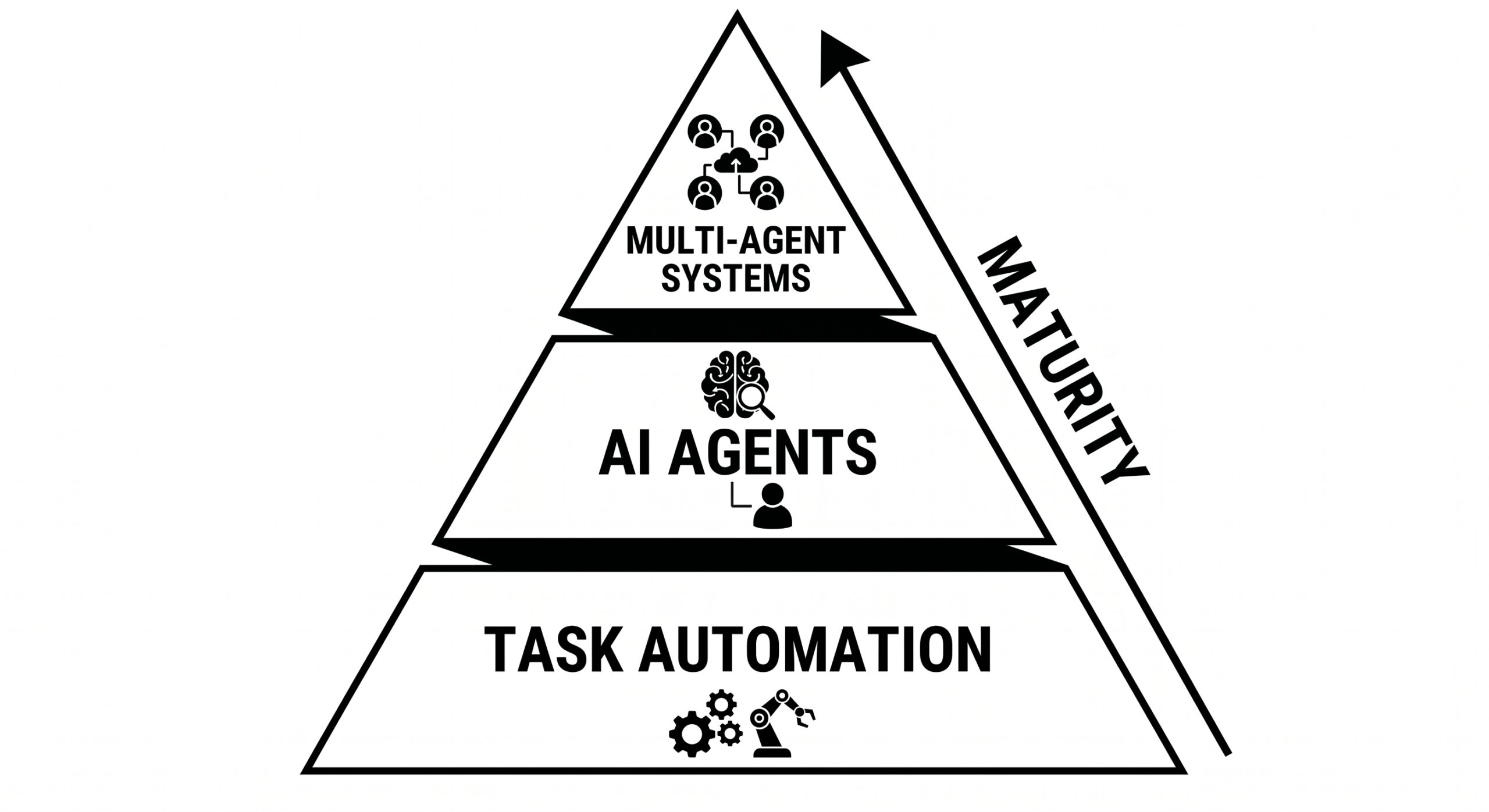
There are three working models in production in 2026:
- Task automation with AI steps — 90% of useful business automation today. Zapier/Make/n8n flows with LLM steps wired in. Deterministic, observable, easy to debug.
- AI agents for scoped jobs — Single-purpose agents (research, outreach, triage) with tool access and guardrails. Useful, but need human-in-the-loop for the next 12–24 months.
- Multi-agent systems — Still mostly theatre. Impressive demos, fragile in production. Almost no mid-market business needs these yet.
The winners in 2026 build category 1 aggressively, category 2 carefully, and ignore category 3 until it matures.
Why AI Automation Matters in 2026
1. Labour cost compression is structural. Ops, customer success, sales development, and marketing ops roles have all seen headcount freezes or reductions. Leaders are under pressure to scale output without scaling team size. AI automation is the lever that works.
2. Tooling matured. n8n hit production-ready. Zapier launched reliable AI actions. Claude, GPT, and Gemini all have function-calling that works. The pieces now fit together; this wasn’t true 18 months ago.
3. Data is already where AI needs it. Most businesses spent 2022–2024 consolidating into HubSpot, Salesforce, Segment. That gave AI a clean data layer to work on top of — which is why implementations that would have been impossible in 2023 ship in a week now.
How AI Automation Works (Practically)
Four components make up almost every useful AI automation running in production today.
1. Trigger
What starts the workflow. New lead in HubSpot. New ticket in Zendesk. New review on G2. Incoming email. Scheduled cron.
2. Context Retrieval
Pulling the data the AI needs to do the job. Contact history from CRM. Account firmographics. Past conversations. Product docs. This is where most AI automations quietly fail — the model gets the wrong context.
3. LLM Step
The language model does its work: classify, extract, summarise, write, decide. Prompt matters. Model choice matters (Claude for reasoning, GPT for breadth, Gemini for multimodal, Haiku/Mini for cost-sensitive volume work).
4. Action + Observability
Write back to the CRM. Send the email. Post to Slack. Crucially, log what happened so you can debug when it breaks. Automations without logging are automations you can’t trust.
Step-by-Step: Shipping AI Automation That Returns ROI
Step 1 — Audit. List every repetitive task across ops, marketing, sales, support. For each, note: volume per week, time per task, who does it, where data lives, what the output looks like.
Step 2 — Prioritise by ROI-per-week-saved. High-volume, low-complexity, data-clean tasks first. Inbound lead enrichment. Support ticket triage. Meeting note summarisation into CRM. CSV cleanup. Ignore the dream projects — ship the boring wins first.
Step 3 — Build with human-in-the-loop. Every automation’s first version should log to Slack or email for human review before writing back to systems. Catch errors in staging, not in a CRM full of garbage.
Step 4 — Instrument. Measure time saved, error rate, completion rate. If you can’t measure it, you can’t defend it to the CFO or iterate on it.
Step 5 — Scale. Move to full auto only after error rate sits under 5% for a month. Graduate the next priority use case.
Not sure where to start with AI automation? Our AI automation agency runs free 60-minute audits — we’ll map the five highest-ROI automations specific to your stack and team. Book an AI automation audit.
Best Tools for AI Automation in 2026
- n8n — Open-source, self-hostable, most powerful for serious builds. Category leader for mid-market.
- Zapier + Zapier Central — Broadest integration library. Best for non-technical teams.
- Make.com — Strong visual flows, cheaper at scale than Zapier.
- Claude (Anthropic) — Best for reasoning, classification, long-context work. Claude Opus 4.7 for high-stakes. Haiku 4.5 for cost-sensitive volume.
- OpenAI (GPT-5 tier) — Strong on breadth, excellent function-calling.
- Gemini 2.5 — Multimodal, strong for document processing.
- Pinecone / Chroma / Supabase Vector — For retrieval-augmented automations (e.g. support, docs).
- Arcade / Composio — AI-native tool layers for agent workflows.
- Langfuse / Helicone — Observability for LLM calls. Non-negotiable for production.
For the deeper implementation playbook, see how to automate your marketing stack with AI and 15 AI workflows for SaaS.
Common Mistakes in AI Automation
1. Starting with the sexy use case. “Let’s build an AI sales agent.” Six months later, nothing in production. Fix: start with a workflow that already has a spreadsheet or a checklist — automate that first.
2. No observability. Automations run silently. When they break, nobody notices until the CRM is full of nonsense. Fix: log every LLM call, alert on failures.
3. Wrong model for the job. Using a frontier-tier model for classification (expensive, overkill) or a small model for reasoning (unreliable). Fix: match model to task complexity.
4. No fallback path. Model returns nonsense, automation writes nonsense to the CRM. Fix: validation layer that catches out-of-distribution outputs and routes to human review.
5. Building in-house without automation engineering experience. Prompt engineering alone isn’t enough — you need eval frameworks, observability, and security review. Most mid-market businesses get to production faster with an AI automation partner than hiring in.
FAQ
What are the best AI automations for a small business?
Lead enrichment, meeting note summarisation into CRM, inbound email classification, invoice data extraction, support ticket triage. All return measurable time savings within two weeks.
How much does AI automation cost to implement?
Tooling: $50–$500/month per workflow for mid-volume use. Implementation: £3–8k / $4–10k per workflow via a specialist agency. Most businesses recoup cost inside 90 days.
Do I need an AI automation agency, or can I DIY?
DIY works for simple Zapier flows. For anything with CRM writes, error handling, or production reliability requirements, the time cost of getting it right in-house usually exceeds the agency cost. See how to choose an AI automation agency.
Will AI automation replace my team?
For specific task categories, yes. For most knowledge work, no — what it does is compress how many people you need for a given output volume. Teams that adopt early generally grow their remaining roles rather than shrinking headcount.
Is AI automation secure?
Depends entirely on the build. Workflows that send PII to third-party LLMs without DPA coverage are a compliance risk. Workflows that use Claude/OpenAI Enterprise, self-hosted n8n, and PII redaction are defensible. Get this right at design time, not after launch.
Conclusion: Pragmatic AI Automation Wins
The businesses winning at AI automation in 2026 aren’t the ones with the most agents. They’re the ones shipping boring, reliable, well-instrumented workflows that save the ops team 20 hours a week — and then shipping another one next month. Compounding beats moonshots.
If you’re serious about building an AI automation programme, start with an audit. You almost certainly have five workflows live right now that would return ROI inside a quarter — you just don’t know which ones.
Our AI automation agency runs free audits for mid-market businesses and SaaS companies across the UK and USA. Book your AI automation audit — 60 minutes, we map your five highest-ROI automations, no pitch.
The AI Automation Opportunity Map
— the Notion template we use on every audit to score and prioritise automation candidates by ROI, complexity, and data readiness.