Tag Archives: cro

Shopify Conversion Rate Optimization: 14 Tactics That Work in 2026

Most Shopify CRO content you’ll read is recycled 2018 tactics. “Add urgency.” “Use FOMO.” “Simplify checkout.” If any of that still moved numbers on your store, you wouldn’t be reading this.

This is what actually works on modern Shopify stores in 2026. 14 specific tactics that drive AOV lift, reduce checkout abandonment, and increase repeat purchase rate. Not theory. Not theatre. Tactics we’ve tested repeatedly.

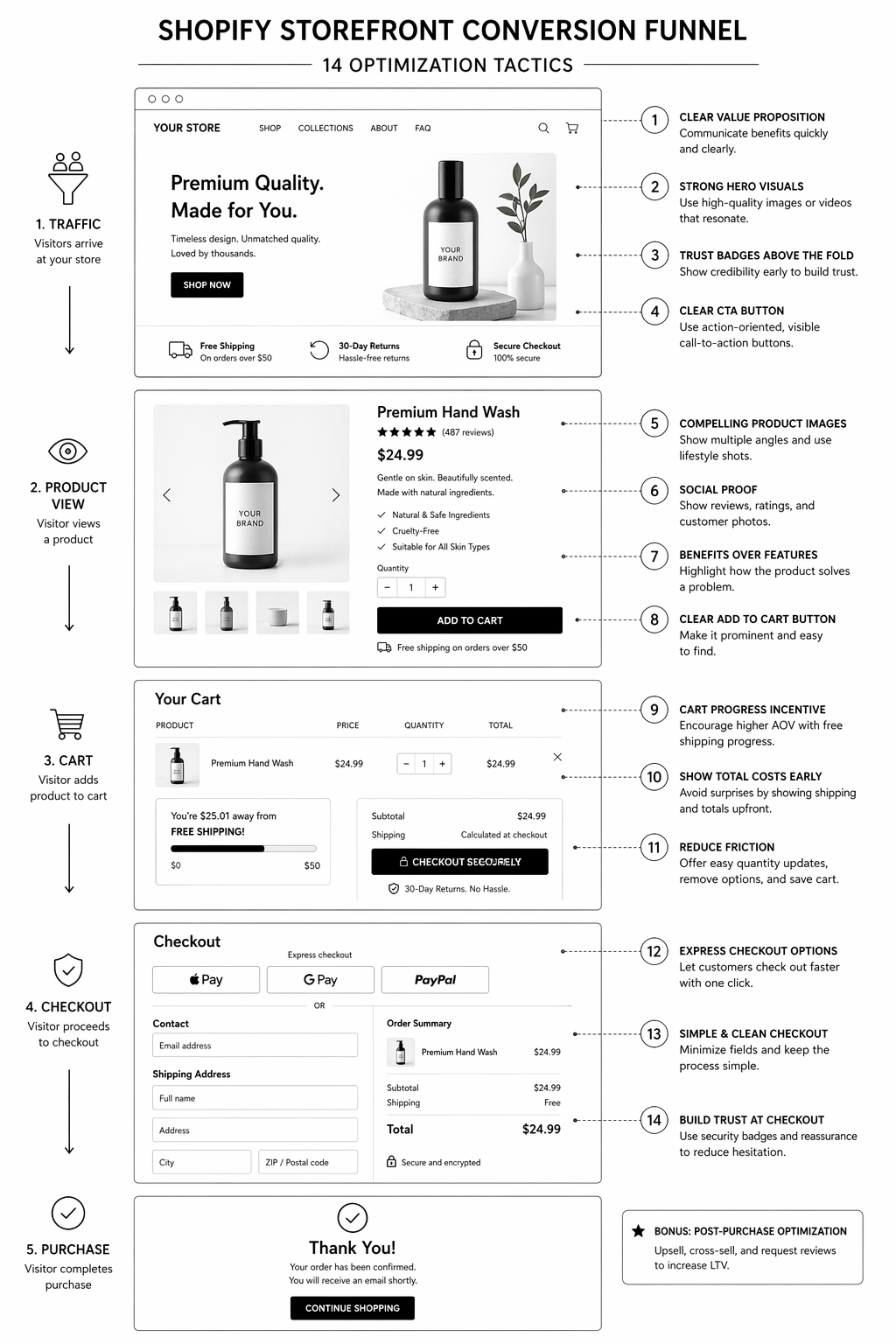
The 14 Tactics That Actually Lift Shopify Conversion

1. Product page specificity, not generic copy. Instead of “Premium quality,” show: “Designed for X outcome. Used by Y companies. Z% report improvement in [specific metric].” Specificity converts 20–40% better than benefits-language.

2. Checkout extensibility through custom payment UI. Custom payment method presentations, conditional payment routing, and brand-matched payment method graphics. Reduces friction and cart abandonment 10–15%.

3. Smart post-purchase recommendations in email. Not generic “other customers bought,” but: “Next step based on what you purchased.” Order-context recommendations increase CLTV 15–25%.

4. Gated high-AOV upsells at decision point (not checkout). Offer the premium version on product page before they add to cart, not as a checkout upsell. Psychological shift from “forcing” an add-on to “giving them the best option.”

5. Live inventory indicators on high-velocity products. “Only 3 left” on items with real low stock. Fake scarcity backfires. Real scarcity converts.

6. Variant-specific social proof and reviews. “Colour: Blue — 247 reviews, 4.8 stars” next to variant selector, not aggregated at page level. Variant-specific trust signals lift conversion 12–20%.

7. Subscription toggle prominently featured above price. If you offer subscription, put it near the top: “Save 20% with auto-delivery.” Toggle position and framing matter more than discount size.

8. Abandoned checkout recovery sequence (email + SMS). Hour 1: Email with click-back link. Hour 24: SMS with urgency (“Sale ends in 12 hours”). Hour 48: Email with incentive if needed. Standard flow recovers 20–30% of abandons.

9. App stack optimisation and script consolidation. Every app adds weight. Audit apps quarterly. Remove 50% of unused apps. Page speed improvement often lifts conversion 5–10%.

10. Bundle pricing psychology (% off → fixed savings). “20% off when you buy three” converts worse than “Save £15 when you buy three.” Show savings in pounds/dollars, not percentages. AOV lifts 15–25%.

11. Return guarantee as trust builder above fold. “60-day money-back guarantee” or “Free returns on everything” visible on hero, not buried in footer. Removes purchase hesitation on first-time buyers.

12. Shipping cost transparency (and flat-rate option). Calculate shipping upfront before cart. Offer flat-rate option. Hidden or unexpected shipping costs cause 20–30% of checkout abandons.

13. Customer testimonials with usage context. Not just “Love this product!” but “I use this 4x/week for X workflow. It’s replaced Y tool.” Specific usage wins over generic praise.

14. Exit-intent offer (but only for 50%+ bounce risk). Don’t show exit-intent on engaged visitors. Segment by time-on-page and scroll depth. Use exit-intent only for low-engagement visitors with abandoned carts. Irrelevant offers backfire.
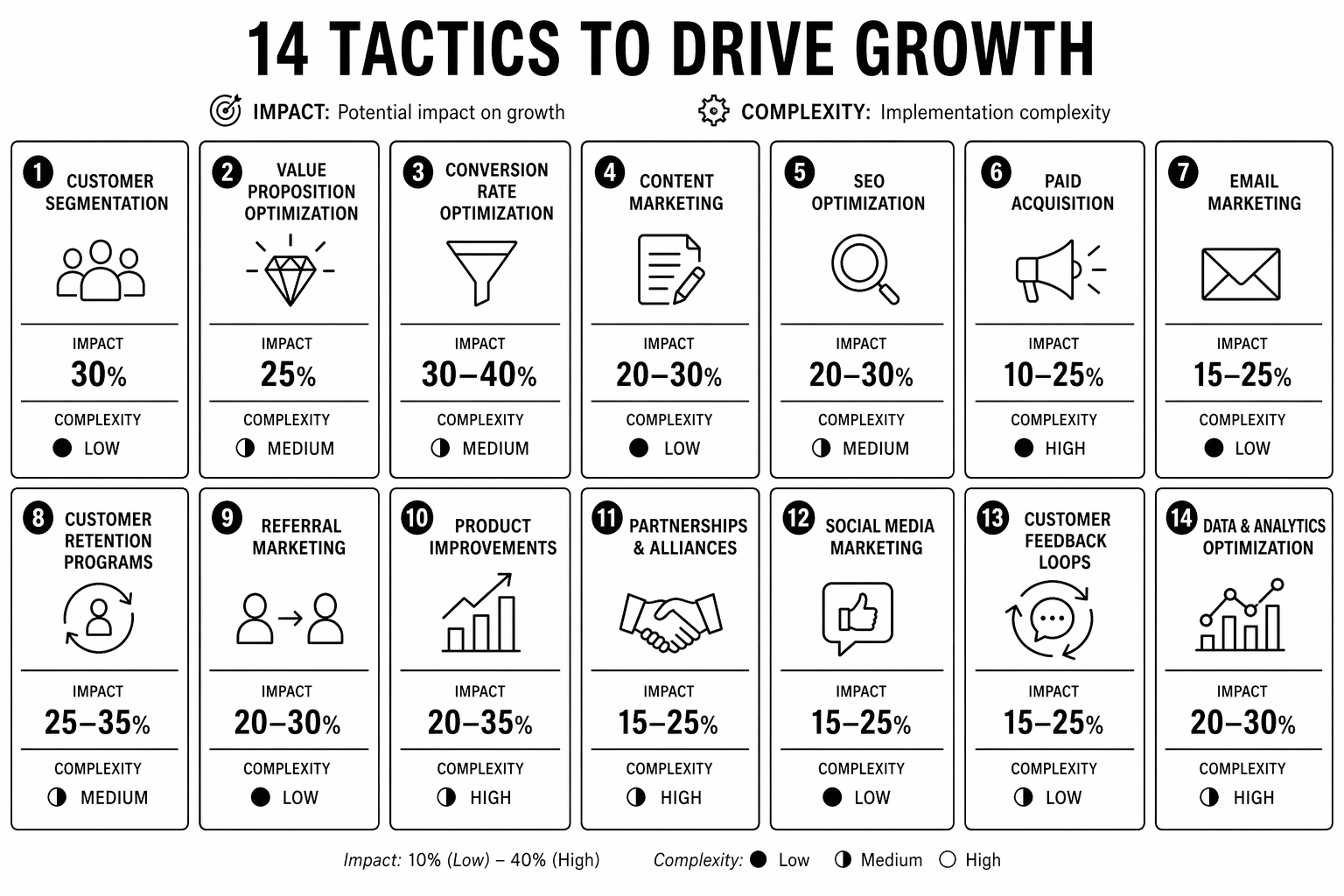
Testing Hierarchy: Start Here

High impact, low effort (start here): Tactics 1, 5, 6, 7, 11, 12. Ship these in the next 2 weeks.

Medium impact, medium effort (run concurrently): Tactics 2, 3, 8, 10, 13. Ship these in weeks 3–6.

Lower priority but valuable: Tactics 4, 9, 14. Ship if time/resources allow, but earlier wins usually outpace these.

Don’t implement all 14 at once. Ship 3–4 tactics, measure for 2 weeks, then ship the next batch. Compound small wins beat big bang launches.

Running a Shopify store and want expert eyes on your CRO roadmap? Our Shopify specialists run free store teardowns. Book one and we’ll show you the three highest-impact tactics for your store specifically.

Common Shopify CRO Mistakes

1. Testing checkout changes without proper staging. Every change impacts SKU data, analytics, and customer trust. Test staging before production.

2. Ignoring email in CRO. Cart abandonment recovery is 30–40% of ecommerce CRO impact. If you’re not email-focused, you’re missing the biggest lever.

3. Over-optimising for AOV at expense of conversion. Higher prices and more upsells = fewer buyers. Test the conversion-AOV trade-off before you optimise for price alone.

4. Shipping costs as an afterthought. Shipping surprises at checkout cause 20–30% abandonment. Get shipping strategy right before you optimise anything else.

5. Not measuring post-purchase experience. 50% of CRO impact is retention and repeat purchase. If you only optimise for first purchase, you’re leaving 2–3x on the table.

For broader ecommerce platform strategy, see Shopify vs other platforms. For the strategic CRO playbook across all platforms, see the complete CRO playbook.

FAQ

What’s a good Shopify conversion rate in 2026?

DTC ecommerce: 2–4% is benchmark. 4%+ is strong. 1% is weak. Your category matters — luxury goods typically 0.5–1%, mass market 2–4%.

How long before I see CRO lift?

First tactic usually shows measurable movement within 2–3 weeks. Compounded lift from 5–6 tactics usually shows at month 6–8.

Should I hire a CRO expert or do it in-house?

CRO is a discipline that requires testing literacy and stats knowledge. In-house works if you have that. Otherwise, specialist usually ships faster and avoids expensive mistakes.

What’s the biggest CRO ROI lever on Shopify?

Email and abandoned cart recovery, by far. One well-executed abandoned cart flow (Tactic 8) usually beats all other optimisations combined.

Can I run all 14 tactics at once?

No. You’ll confound results and can’t debug. Ship 3–4, measure, iterate. Sequential testing + learning beats big bang launches.

Conclusion: CRO Is Systematic, Not Sporadic

The brands with the best Shopify conversion rates in 2026 don’t have magical landing pages. They have systematic CRO programmes that ship tactics weekly, measure rigorously, and compound lift quarter over quarter.

Use this framework. Start with tactics 1–7. Measure. Iterate. You’ll see 15–30% conversion lift within 90 days if you stay disciplined.

Our Shopify team runs CRO programmes on DTC stores across UK and USA. Book a store audit if you want expert guidance on your specific teardown.

📥 Free resource: The Shopify CRO Tactics Checklist — a practical implementation guide for all 14 tactics with setup steps per tactic.
That's enough scrolling for now - chat to a HubSpot expert today!
Contact Us
Landing Page Optimization for SaaS: 21 Tactics That Actually Work

Most SaaS landing page content online is recycled tactics from 2019. “Add social proof.” “Use power words.” “FOMO sells.” None of that moves modern B2B buyers in 2026.

This is what actually converts on SaaS landing pages now. 21 specific patterns, placements, and micro-copy changes that move qualified demo requests 20–40%. Not theory, not trends. Real tactics on real campaigns.

The 21 Tactics That Move SaaS Landing Pages

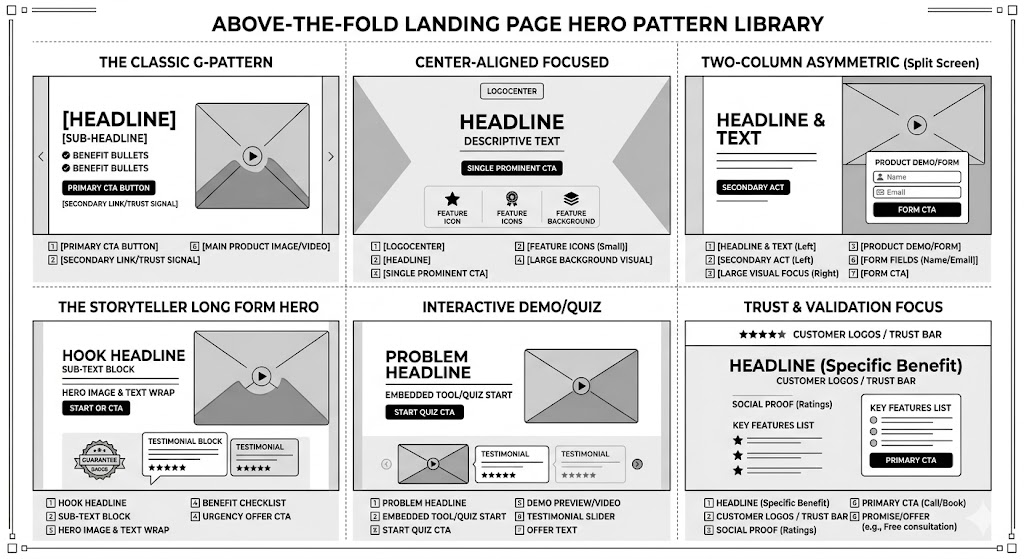
Hero Section (Tactics 1–4):

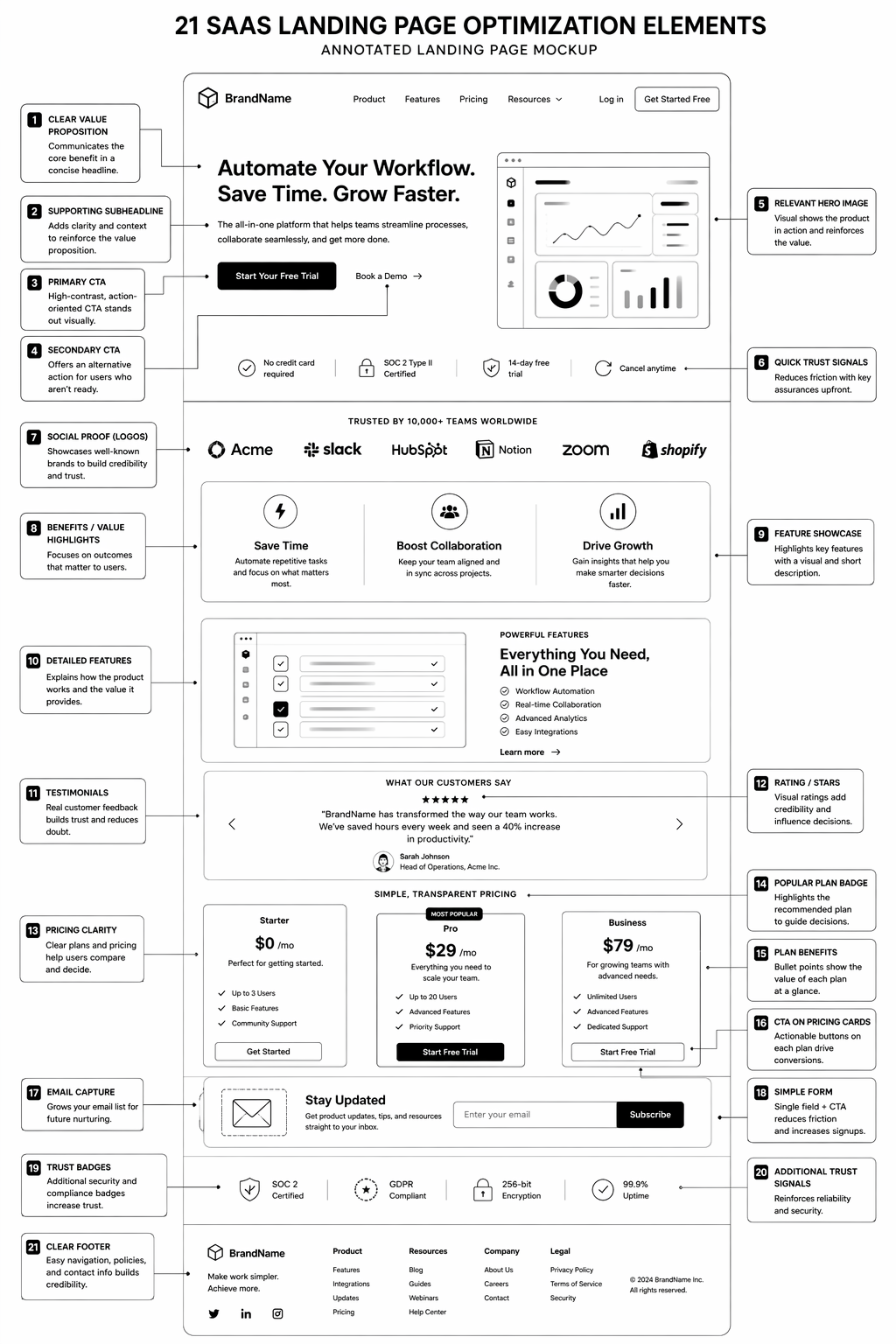
1. Lead with specific outcome, not product name. “Reduce customer churn by 25% using AI-powered predictive analytics” beats “Meet ChurnAI.” Outcome first, product second. Moves visitors from “what is this?” to “do I need this?” instantly.

2. Sub-headline should answer “for whom?” “Built for B2B SaaS leaders managing 100–1,000 customers” beats generic “for every business.” Micro-segmentation increases relevance and qualification.

3. Call-to-action button changes copy by audience segment. Known visitors see “Start free trial.” Unknown visitors see “See how it works.” Decision-stage changes copy. Use dynamic CTA when possible.

4. Trust bar above the fold (not below). Customer logos, certification badges, review scores visible in hero. Not at bottom of page. Removes objection before they scroll.

Social Proof (Tactics 5–8):

5. Named customers + specific results. “Acme Corp reduced onboarding time from 4 weeks to 5 days” beats “Trusted by 500+ companies.” Specificity builds trust faster than numbers.

6. Review aggregators displayed early and prominently. G2 verified badge, Capterra score, Trust Radius ranking. Third-party validation carries more weight than self-reported testimonials.

7. Customer testimonial includes use case and metric. “We use this for sales forecasting. Accuracy improved 30%” beats “Great tool, highly recommend.” Metric-backed testimonials move SaaS buyers.

8. Competitive comparison testimonials (use cautiously). “Switched from [competitor]. This is 3x faster and 50% cheaper” moves technical buyers. Use sparingly and only with true comparisons.

Form and CTA Placement (Tactics 9–12):

9. Form right-side, not bottom-of-page. Visible on viewport without scrolling (on desktop). Right-side converts 20–30% better than below-the-fold. Mobile: consider embedded form mid-page instead.

10. Form fields reduced to 3–4 maximum. Every field reduces conversion 10–15%. If you need 10 fields, ask them later post-signup. Friction earlier usually means no conversion.

11. CTA button copy matches commitment level. “Get demo” for high-touch. “Start free trial” for self-service. “See pricing” for browsers. Copy should reflect actual next step.

12. Qualifying question in form (before they submit). “What’s your current annual recurring revenue?” Answers self-select who converts. Garbage-in-garbage-out on leads, but higher-quality respondents overall.

Value Prop and Objection Handling (Tactics 13–17):

13. Objection-handling section (near CTA). “How is this different from [competitor]?” answered in a single sentence. “When can I get started?” answered explicitly. Removes friction from buying.

14. Feature bullets speak to problem, not feature. “Reduces cycle time” beats “Sales forecasting module.” Problem-to-solution language converts better than feature-to-benefit language.

15. Use case or vertical segmentation visible early. Pharma, fintech, SaaS buttons that show use-case-specific value. Buyers want to see themselves reflected, not generic positioning.

16. Security and compliance badges on form section. SOC 2 badge, HIPAA certified, GDPR compliant. Enterprise buyers need this visible before they’ll enter email.

17. Pricing anchor (if not on separate page). “From £99/month” visible, even if full pricing is elsewhere. Removes sticker shock and lowers barrier to inquiry.

Scarcity and Momentum (Tactics 18–21):

18. Real scarcity (not fake). “Only 5 spots left this month for setup consultation” works if true. Fake scarcity backfires when discovered. Use real scarcity or don’t use it.

19. Social proof of momentum. “500+ companies launched this month” or “Added 20 Fortune 500 companies this year” speaks to growth, not just adoption.

20. FAQ section answers top objections. Not generic “how much?” but “how long to see ROI?” and “can I cancel anytime?” Real questions prospects ask, not theoretical.

21. Personal note or credibility signal from founder/CMO. “Hey, I’m [name], we built this because…” humanises the page and builds trust. Optional, but effective on high-touch pages.

Testing Framework: What to Test First

High impact, low effort: Tactics 1–2 (headline/sub), 4 (trust bar above fold), 10 (form field count), 11 (CTA copy).

Medium effort, high impact: Tactics 3 (dynamic CTA), 5–7 (social proof specificity), 13–14 (objection handling, feature bullets).

Lower priority: Tactics 18–21 (scarcity, FAQ, founder note) are validating, not core to conversion.

Want a free teardown of your SaaS landing page? Our CRO team analyzes high-traffic pages and identifies your top 3 quick wins. Book a landing page audit.

FAQ

What’s a good demo request conversion rate for SaaS landing pages?

2–5% for awareness-stage traffic. 5–15% for intent-driven traffic. If you’re below 2%, something structural is broken.

Should my landing page be long or short?

Long (3,000+ words) works for complex, high-ticket products. Short (500–800 words) works for simple, self-serve products. Test both; measure time-on-page and bounce rate.

Can I test these 21 tactics all at once?

No. Test 1–2 tactics per cycle. Measure for 2 weeks minimum. Compound small wins beat big overhauls.

What’s the fastest way to improve landing page conversion?

Fix form field count (Tactic 10). Reduce from 8 fields to 3 fields. Conversion usually lifts 15–25% within 1 week.

Should I hire a landing page specialist?

For mission-critical landing pages, yes. For experimentation, in-house works if you have CRO literacy. Most companies benefit from expert eyes at least once.

Conclusion: Landing Pages Compound Over Iterations

The best SaaS landing pages aren’t the result of one big redesign. They’re the result of 12+ monthly iterations, each tactically grounded in data.

Start with tactics 1–11. Measure. Iterate. You’ll reach 8–12% demo request conversion within 90 days if you stay disciplined.

Our CRO team runs landing page audit and builds programmes for SaaS companies. Book a teardown if you want expert guidance on your specific page.

📥 Free resource: The SaaS Landing Page Teardown Template — an audit framework to evaluate any landing page against all 21 tactics.

That's enough scrolling for now - chat to a HubSpot expert today!
Contact Us
Conversion Rate Optimization: The Complete 2026 Playbook

Most conversion rate optimization content you’ll read this year is a reheat of 2019 tactics. “Add urgency.” “Use exit-intent popups.” “A/B test the button colour.” If any of that still moved numbers on your site, you wouldn’t be reading this.

This is the honest 2026 CRO playbook — frameworks, prioritisation, and specific tests that work on modern SaaS and ecommerce sites where buyers are skeptical, privacy-aware, and have seen every trick. Written for marketing leaders, growth heads, and founders responsible for conversion targets.

What CRO Actually Is in 2026

CRO is the discipline of systematically increasing the percentage of visitors who take a desired action — demo request, signup, checkout, subscription. In 2026, that definition sits on top of three shifts that redefine how the work is done:

  • Attribution is broken, so CRO relies more on on-site behaviour and less on channel-level lift.
  • Buyers are saturated, so persuasion tactics that felt clever in 2019 now feel like manipulation and repel.
  • LLMs are in the research path, so buyers arrive to your landing page already primed — meaning your page has to deliver the specific answer they came for, not introduce the problem.

The practical result: modern CRO is less about UI tricks and more about clarity, specificity, and trust. Conversion rate optimization is now a positioning and content problem as much as a design problem.

Why CRO Matters More in 2026 Than Ever

1. Paid CAC keeps climbing. Meta and Google CPMs are up 20–40% over 2024 in most verticals. The only defensible response is to convert a higher share of the traffic you already buy. Every 0.5-point conversion lift pays for a quarter of CRO investment.

2. Organic traffic is getting noisier, not more qualified. AI overviews are skimming top-of-funnel answers, so the visitors who do land on your site are later in the buying process and more price-aware. They need faster, sharper conversion paths.

3. SaaS retention is a conversion problem now. Activation, expansion, and upgrade are all conversion events. Modern CRO programmes run across the whole lifecycle, not just the marketing site.

If you’re running Shopify, pair this with our Shopify CRO tactics. If you’re SaaS, see SaaS landing page optimization.

How a Real CRO Programme Works

Every credible CRO programme runs on the same four-part loop. Teams that skip any of the four produce noise, not lift.

1. Research

Analytics, session replay, on-page surveys, user interviews, funnel analysis, competitor teardowns. Output: a list of specific friction points with evidence, not opinions.

2. Hypothesis

Every test gets a written hypothesis: “Because [evidence], we believe [change] will cause [specific metric] to [direction] by [amount].” If you can’t write this in one sentence, you’re not ready to test.

3. Experiment

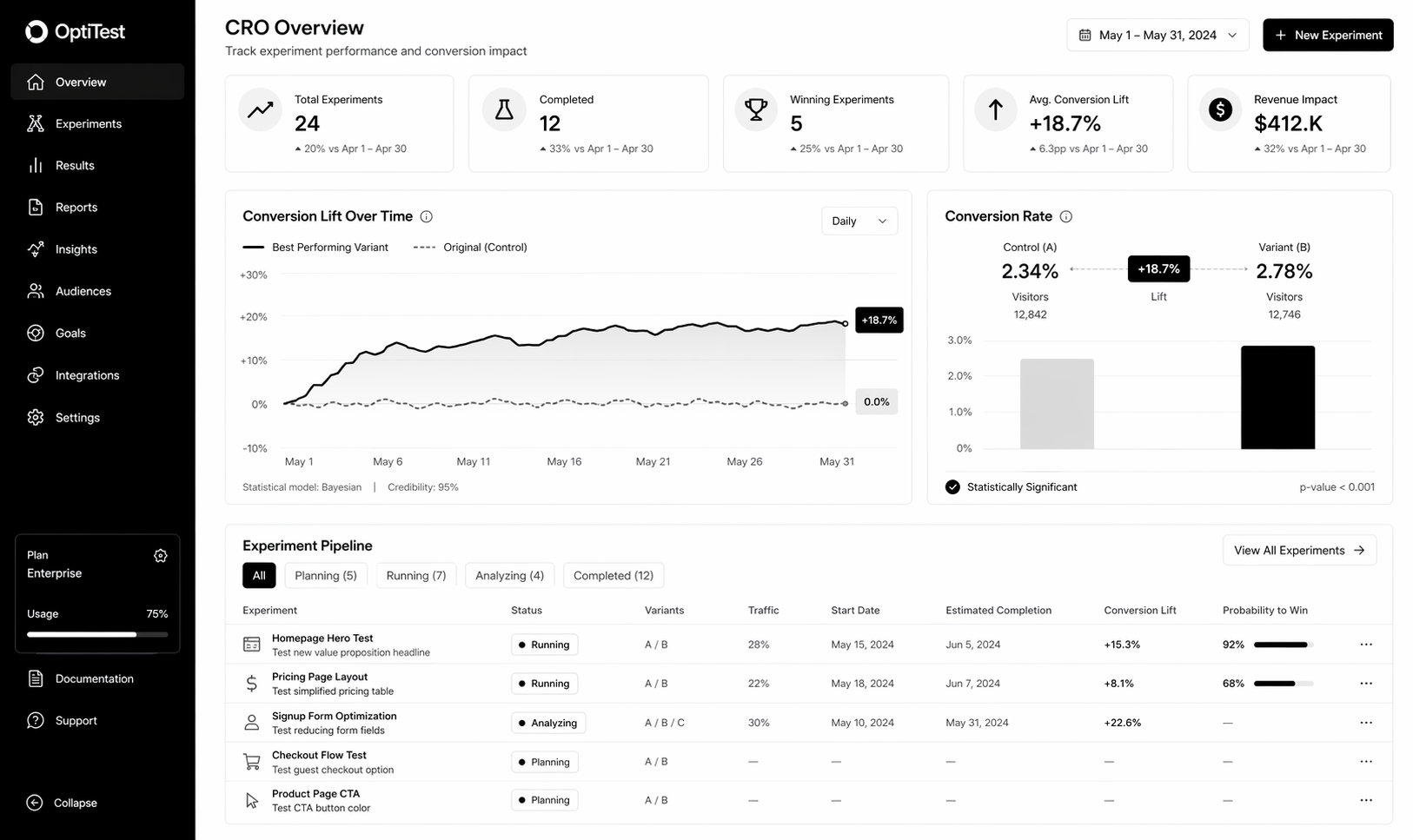
Design, build, QA, launch, monitor. Sample size calculated in advance. No peeking and stopping early. Test runs for full business cycles, not random durations.

4. Decide + Ship

Statistical significance reviewed. Winner shipped or losing variant killed. Learnings logged in a knowledge base. Next experiment primed.

Step-by-Step: Building a CRO Programme That Ships Lift Every Month

Step 1 — Instrument properly. Analytics setup audit. Event tracking on every meaningful action. Session replay on key pages. Surveys on intent-signal pages. If your data is dirty, every test result is wrong.

Step 2 — Map conversion baselines. 30-day baseline on every key metric before changing anything. Without this, you can’t defend wins to the CFO.

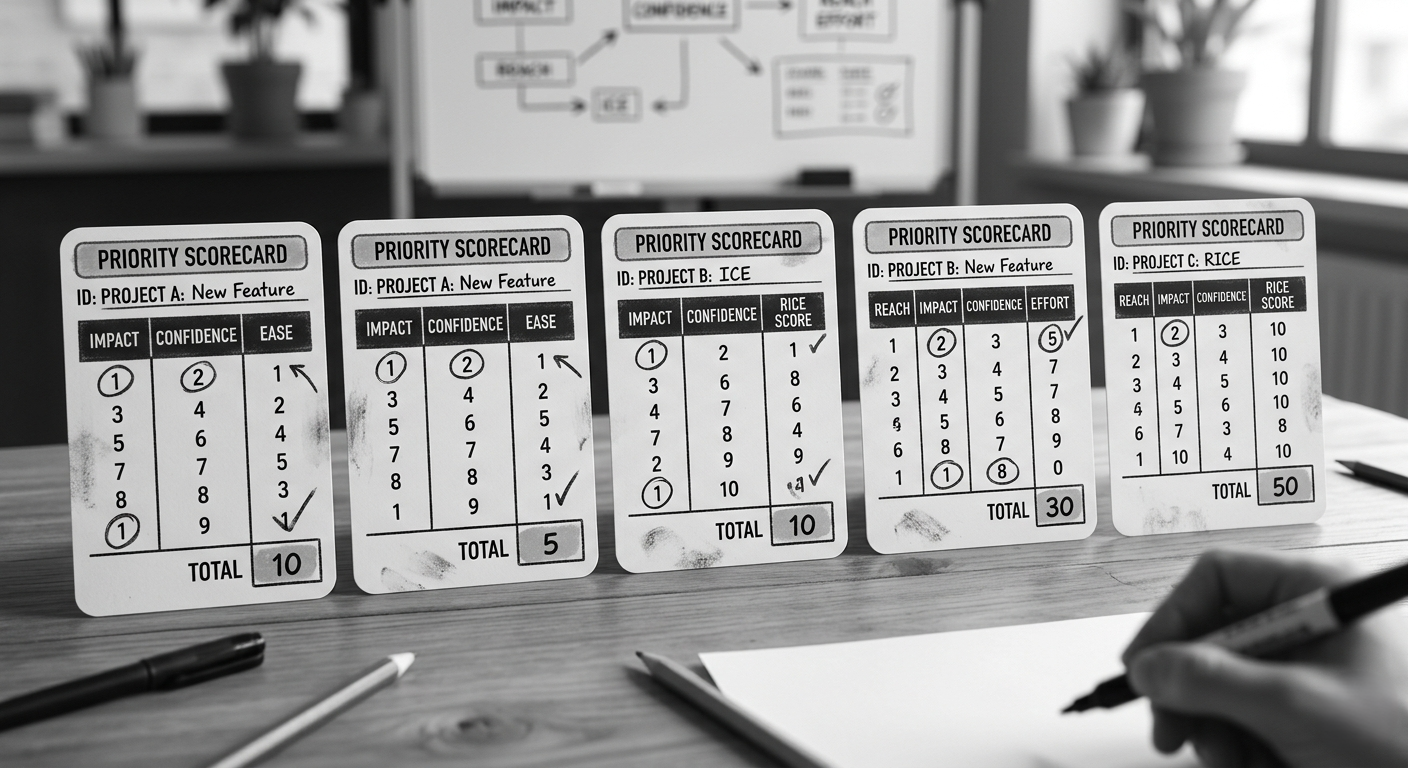
Step 3 — Build a prioritised backlog. Use ICE or RICE. Don’t test everything. Test the experiments with highest expected value first.

Step 4 — Ship tests weekly. Smaller, faster experiments beat huge quarterly overhauls. Ship 3–5 tests per month on a healthy site.

Step 5 — Compound learnings. Losing tests teach more than winning tests. Every experiment’s insight goes into a shared knowledge base.

Step 6 — Ladder up to structural changes. When the same pattern (e.g. pricing confusion) keeps losing tests, it’s not a test problem — it’s a positioning or product problem. CRO points at structural issues; structural fixes multiply the lift.

Running a site that’s converting below your category benchmark? We run free 60-minute CRO audits for SaaS and ecommerce brands. Book a CRO strategy session — we’ll show you the three experiments most likely to move your numbers this quarter.

The CRO Tests That Actually Work in 2026

Not a generic list. These are the experiment categories that consistently return lift in 2026 for B2B and ecommerce sites we run programmes on.

  • Hero clarity test — Replace clever taglines with a specific, mechanism-led value prop. “We do X for Y so you get Z.” Almost always wins against vague brand copy.
  • Social proof stack test — Add quantified, named customer logos + one specific result above the fold. Generic “trusted by 500+ companies” is now ignored.
  • Friction audit on forms — Cut one field at a time, measure completion rate. Most B2B forms have 2–3 fields that don’t need to be there.
  • Pricing page structure — Prospects bounce when pricing forces them to calculate. Test: add a recommended tier highlighted, add comparison rows, add calculator.
  • Objection-handling blocks — Dedicated section near the CTA answering the 3 most common objections your sales team hears.
  • CTA specificity — “Book demo” vs “See pricing” vs “Get 15-min walkthrough.” Intent-aware CTAs routinely lift click-through 20–40%.
  • Case study injection — A customer result card placed mid-page near the CTA, not hidden on a customer page nobody visits.
  • Lifecycle-aware content — On HubSpot, smart content for known vs unknown visitors. Returning customers shouldn’t see “Book a demo.”

Best Tools for CRO in 2026

  • VWO or Optimizely — Enterprise-grade experimentation platforms. Split.io for feature-flag-driven testing.
  • GrowthBook (open source) — Self-hosted experimentation, increasingly popular with engineering-led teams.
  • Hotjar, Microsoft Clarity, FullStory — Session replay + heatmaps. Clarity is free and surprisingly good.
  • Mixpanel / Amplitude — Product-led CRO for SaaS activation and expansion funnels.
  • HubSpot A/B testing — Native for teams already on CMS Hub Professional. See our HubSpot development team’s setup guide.
  • Shopify experiments or Intelligems — Ecommerce testing with conversion and revenue tracking.
  • Unbounce or Instapage — For paid landing page testing without a developer.
  • Typeform or Sprig — On-site surveys and qualitative research.

Common CRO Mistakes

1. Testing button colours. Rounding error. Stop. Test copy, structure, offer.

2. Peeking at results and stopping early. Tests stopped before significance are guessing, not science. Run full duration.

3. No research before testing. Teams pick tests off Twitter. Zero relevance to their site. Fix: research first, hypothesis second, test third.

4. Running tests on low-traffic pages. Not enough sample to reach significance. Fix: run tests on your highest-traffic pages first.

5. No learning repository. Same losing tests re-run every 18 months because nobody remembers. Fix: document every test + outcome in a shared Notion or Airtable.

6. Treating design as the only variable. The biggest conversion lifts come from positioning, pricing, and offer — not design polish. If your website redesign didn’t change what you say, it probably won’t change conversion either.

FAQ

What’s a good conversion rate in 2026?

Benchmark depends on vertical. B2B SaaS marketing site to demo: 2–4%. Ecommerce DTC: 2.5–4%. High-ticket B2B: 0.5–2%. Good is relative to your history and category median — not a universal number.

How long should a CRO test run?

Until you hit a pre-calculated sample size AND at least one full business cycle (usually 2 weeks minimum). Anything shorter is noise.

How much does a CRO programme cost?

In-house: 1–2 headcount plus tooling (£50–150k/year). Agency retainer: £5–20k/month depending on scope. For most mid-market businesses, a specialist CRO agency returns faster than hiring in-house for the first 12 months.

How soon should we see results?

First test in 2–3 weeks. First meaningful win typically within 6–8 weeks. Compounding lift from 3–5 wins usually shows in quarterly numbers by month 4–6.

Do I need a dedicated CRO agency, or can my web agency do it?

Most web agencies design and build. CRO is a different discipline — it’s experimentation, statistics, and behavioural research. A good agency will either have a dedicated CRO team or partner with one.

Conclusion: CRO as a Compounding System

The brands with the best conversion rates in 2026 didn’t get there by running one test. They built a programme that ships five well-researched experiments a month, logs every learning, and compounds lift quarter over quarter.

If your current CRO effort is sporadic — test when we remember, ship when it wins — you’re leaving money on the table every month. The system beats the sprint.

Our team runs CRO programmes for SaaS and ecommerce brands in the UK and USA. If you want to see where your site is leaving conversion on the table, book a free CRO strategy session — 60 minutes, we’ll walk through your analytics and map the three tests most likely to move your numbers this quarter.

📥 Free resource: The CRO Experiment Backlog Template — the Notion template we use to score, prioritise, and track every experiment across a 90-day programme.

That's enough scrolling for now - chat to a HubSpot expert today!
Contact Us
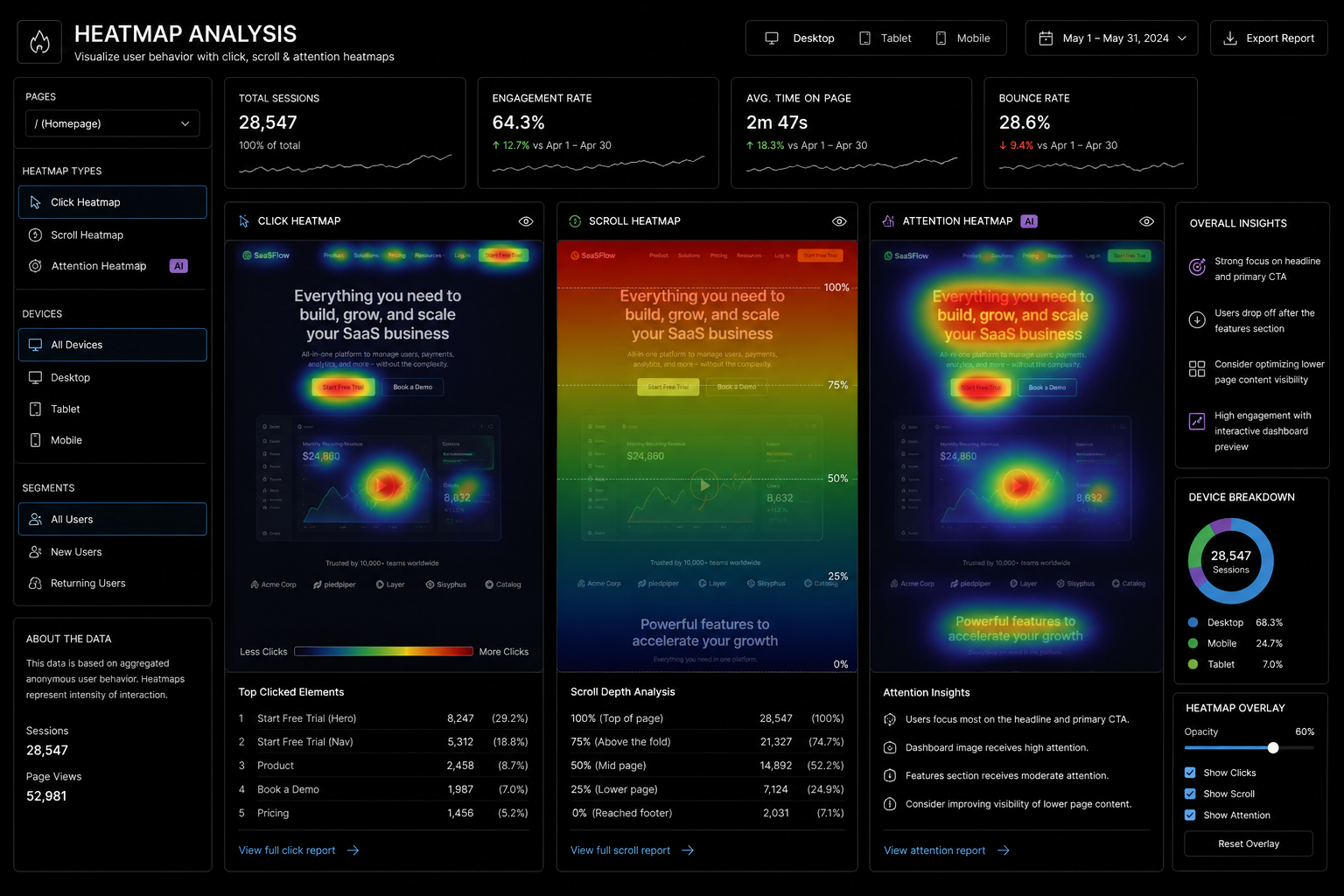
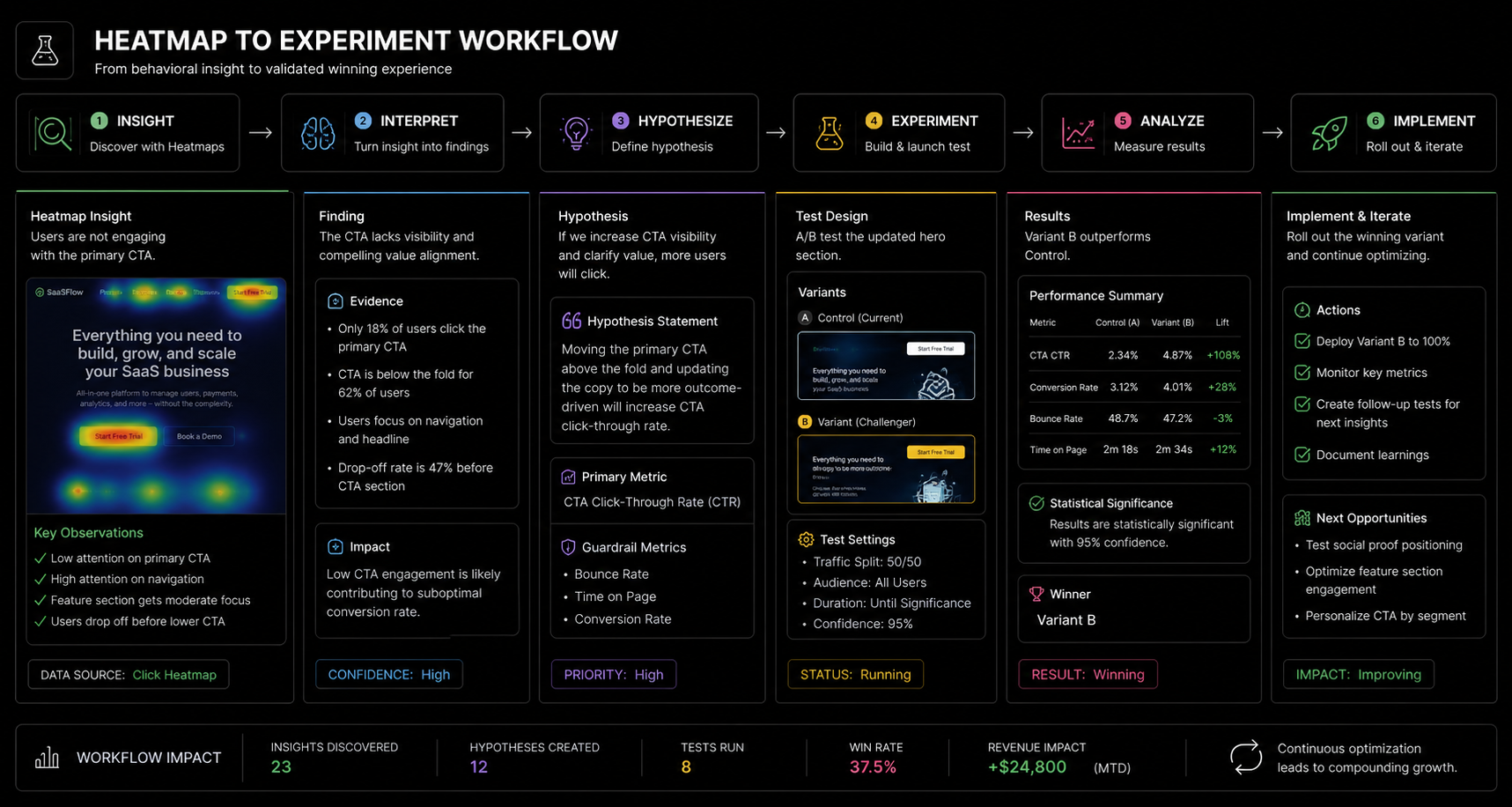
Heatmap Analysis for CRO: How to Read the Data and Win Tests

Heatmap Analysis for CRO in 2026 is won by execution quality, not platform hype. Teams that perform consistently align strategy, implementation, and measurement into one operating system. This guide gives the practical framework, internal link map, and optimization cadence to do that.

Heatmaps don’t tell you what to test. They tell you what’s broken. Here’s the analysis framework that ships winning tests. If you want implementation help, work with book a free consultation. For connected strategy, also review Conversion Rate Optimization Playbook and Ab Testing Saas.

What Heatmap Analysis for CRO Means in Practice

Heatmap analysis for CRO is a diagnostic input, not a decision by itself. Winning teams pair heatmap signals with analytics and experiments to produce reliable conversion gains.

Why heatmap analysis Matters in 2026

1. Most teams collect heatmaps but do not operationalize insights.

2. CRO needs qualitative and quantitative evidence together.

3. Device-specific behavior requires segmented analysis.

Step-by-Step Playbook

1. Segment sessions first

Separate by page intent, device, and traffic source.

2. Find high-friction zones

Identify dead clicks, rage clicks, and early drop-off.

3. Turn insights into hypotheses

Write one testable statement per pattern.

4. Prioritize with scoring model

Use ICE or PIE to sequence experiments.

5. Close learning loop

Feed experiment outcomes back into future analysis.

Mid-article CTA -> Need support applying this to your stack? CRO experiment audit and get a scoped roadmap with timeline, owners, and KPI targets.

Tools, References, and Benchmarks

  • Heatmap annotation template
  • Hypothesis bank
  • ICE prioritization board
  • Semantic keyword targets to distribute naturally: hotjar heatmap analysis, click maps cro, heatmap insights

Use these references during planning and QA: Google Analytics HelpOptimizely A/B testing glossary, and web.dev UX guidance.

Common Mistakes That Kill Performance

  • Treating heatmaps as proof
  • Ignoring segmentation
  • No hypothesis-to-test loop

FAQ – Heatmap Analysis for CRO

How long does a heatmap analysis project usually take?

Most teams can ship an initial version in 4 to 8 weeks, then improve outcomes over one quarter with a weekly optimization cadence.

Is heatmap analysis relevant for UK and US teams?

Yes. The core framework is consistent across both markets. Differences are usually compliance details, buying behavior, and GBP/USD planning.

What should we measure first for heatmap analysis?

Track one leading metric, one conversion metric, and one revenue metric so execution stays tied to business impact.

Should we run this in-house or with a specialist partner?

If your team has deep expertise and bandwidth, in-house can work. If speed and risk control matter, working with a specialist partner is usually faster.

What is the most common failure mode?

Teams skip governance after launch. Data quality drifts, process quality declines, and performance plateaus. A simple weekly operating rhythm prevents this.

Conclusion

Heatmap Analysis for CRO performs best when execution decisions are tied to measurable outcomes from day one. Use this playbook to prioritize what matters, reduce risk, and create a repeatable optimization rhythm.

Want a specialist team to accelerate delivery? Talk to book a free consultation or book a consultation and we will map a practical rollout plan.

Lead magnet: Download the Heatmap Analysis Framework to implement this framework with templates and checklists.

That's enough scrolling for now - chat to a HubSpot expert today!
Contact Us
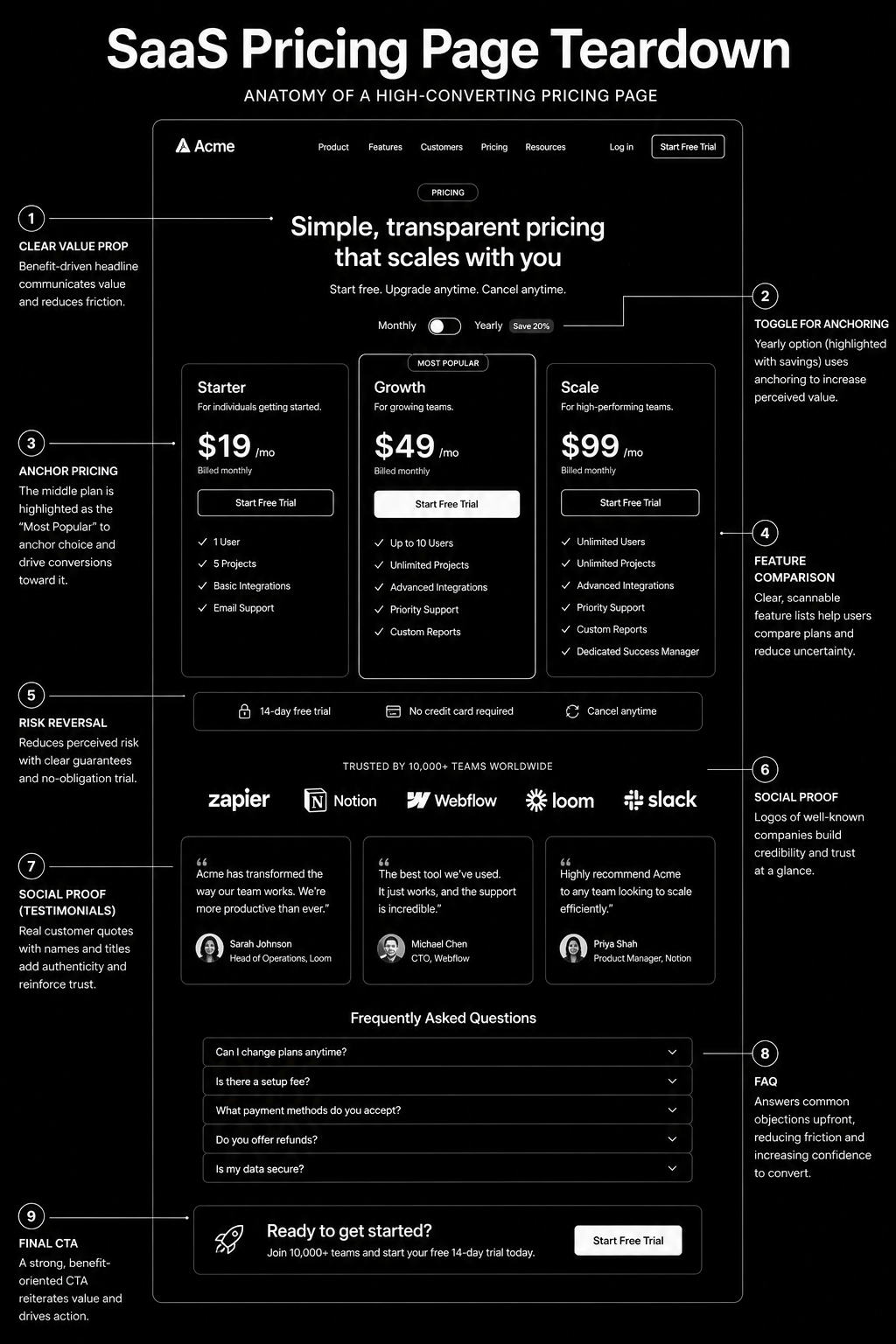
SaaS Pricing Page Best Practices: 19 Tactics That Lift Conversion

SaaS Pricing Page Best Practices in 2026 is won by execution quality, not platform hype. Teams that perform consistently align strategy, implementation, and measurement into one operating system. This guide gives the practical framework, internal link map, and optimization cadence to do that.

SaaS pricing pages are the highest-leverage page on the site. Here are 19 tactics moving conversion in 2026. If you want implementation help, work with book a free consultation. For connected strategy, also review Saas Landing Page Optimization and Conversion Rate Optimization Playbook.

What SaaS Pricing Page Best Practices Means in Practice

SaaS pricing page best practices focus on reducing decision friction and clarifying value quickly. High-performing pages align package logic with buyer intent and handle objections in context.

Why saas pricing page Matters in 2026

1. Pricing pages are high-intent conversion moments.

2. Confusing packaging kills trial starts and demo requests.

3. Small layout and message changes can produce outsized gains.

Step-by-Step Playbook

1. Align packages to buyer segments

Map each plan to clear use cases and triggers.

2. Fix information hierarchy

Place key decision details first: value metric, limits, and upgrade path.

3. Add proof at decision points

Use concise outcomes and social proof near CTAs.

4. Handle objections inline

Answer friction questions where they appear.

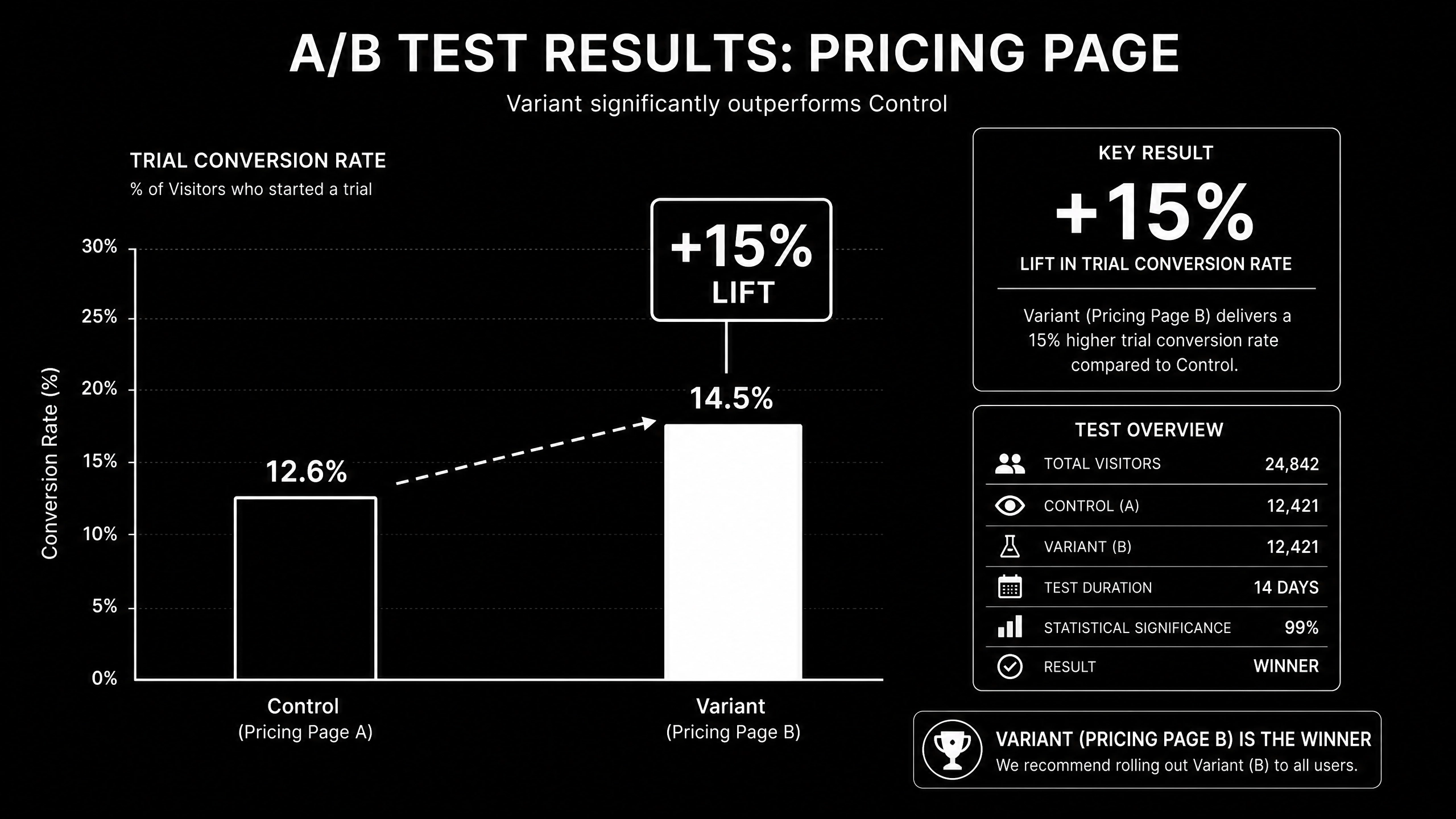
5. Run pricing experiments

Test package order, CTA framing, and feature emphasis.

Mid-article CTA -> Need support applying this to your stack? Pricing page teardown and get a scoped roadmap with timeline, owners, and KPI targets.

Tools, References, and Benchmarks

  • Pricing teardown template
  • Plan clarity rubric
  • Trial-to-paid experiment log
  • Semantic keyword targets to distribute naturally: saas pricing page examples, saas pricing strategy, high converting pricing pages

Use these references during planning and QA: Google Analytics HelpOptimizely A/B testing glossary, and web.dev UX guidance.

Common Mistakes That Kill Performance

  • Feature dump without hierarchy
  • Hiding plan limits
  • No ongoing experiment cadence

FAQ – SaaS Pricing Page Best Practices

How long does a saas pricing page project usually take?

Most teams can ship an initial version in 4 to 8 weeks, then improve outcomes over one quarter with a weekly optimization cadence.

Is saas pricing page relevant for UK and US teams?

Yes. The core framework is consistent across both markets. Differences are usually compliance details, buying behavior, and GBP/USD planning.

What should we measure first for saas pricing page?

Track one leading metric, one conversion metric, and one revenue metric so execution stays tied to business impact.

Should we run this in-house or with a specialist partner?

If your team has deep expertise and bandwidth, in-house can work. If speed and risk control matter, working with a specialist partner is usually faster.

What is the most common failure mode?

Teams skip governance after launch. Data quality drifts, process quality declines, and performance plateaus. A simple weekly operating rhythm prevents this.

Conclusion

SaaS Pricing Page Best Practices performs best when execution decisions are tied to measurable outcomes from day one. Use this playbook to prioritize what matters, reduce risk, and create a repeatable optimization rhythm.

Want a specialist team to accelerate delivery? Talk to book a free consultation or book a consultation and we will map a practical rollout plan.

Lead magnet: Download the SaaS Pricing Page Teardown Template to implement this framework with templates and checklists.

That's enough scrolling for now - chat to a HubSpot expert today!
Contact Us