
 Website Designing
 Web Development
 Mobile Applications
 Marketing
 CMS & Ecommerce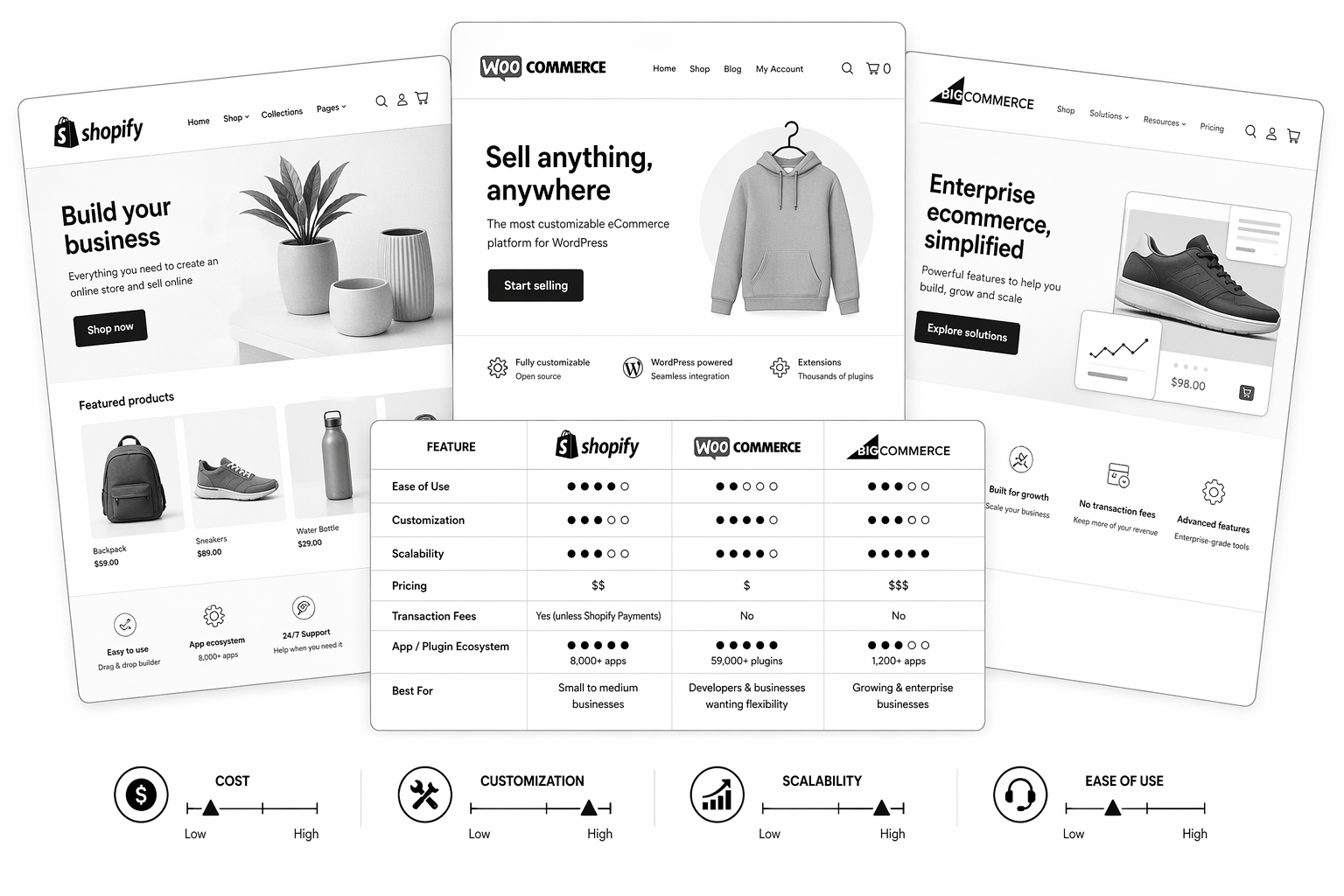
Table of Contents
If you’re choosing an ecommerce platform in 2026, the wrong decision can cost you more than a redesign. It can slow launches, break checkout performance, and create months of technical debt right when your acquisition costs are rising.
This comparison covers Shopify vs WooCommerce vs BigCommerce from an operator perspective: total cost, growth-stage fit, customisation, and what each platform feels like to run at £1M, £10M, and £50M+ revenue.
Quick Verdict by Business Type
- Shopify wins for most fast-scaling DTC brands that need speed, reliability, and app ecosystem depth.
- WooCommerce fits teams needing deep WordPress-level control and willing to own infrastructure complexity.
- BigCommerce works well for catalogue-heavy or B2B-oriented teams needing strong native enterprise features.
If you’re in doubt, default to operational simplicity. The platform your team can run well every week beats the platform with the longest feature page.
Shopify: Best for Speed and Predictability
Shopify is the default recommendation for most growth ecommerce teams because it reduces technical overhead. Hosting, checkout reliability, and app integrations are mature, and launch velocity is usually faster than alternatives.
For brands heading into Plus territory, the strategic path is usually clear: build stable foundations now, then scale with structured Shopify Plus development as complexity grows.
WooCommerce: Maximum Flexibility, Maximum Responsibility
WooCommerce offers extensive control because it sits on WordPress. That freedom is useful for custom requirements, but it also means your team owns hosting quality, plugin compatibility, security updates, and performance governance.
WooCommerce can absolutely scale. It just requires disciplined technical ownership. Many brands underestimate this and only discover the maintenance burden during peak season.
BigCommerce: Strong Mid-Market and B2B Option
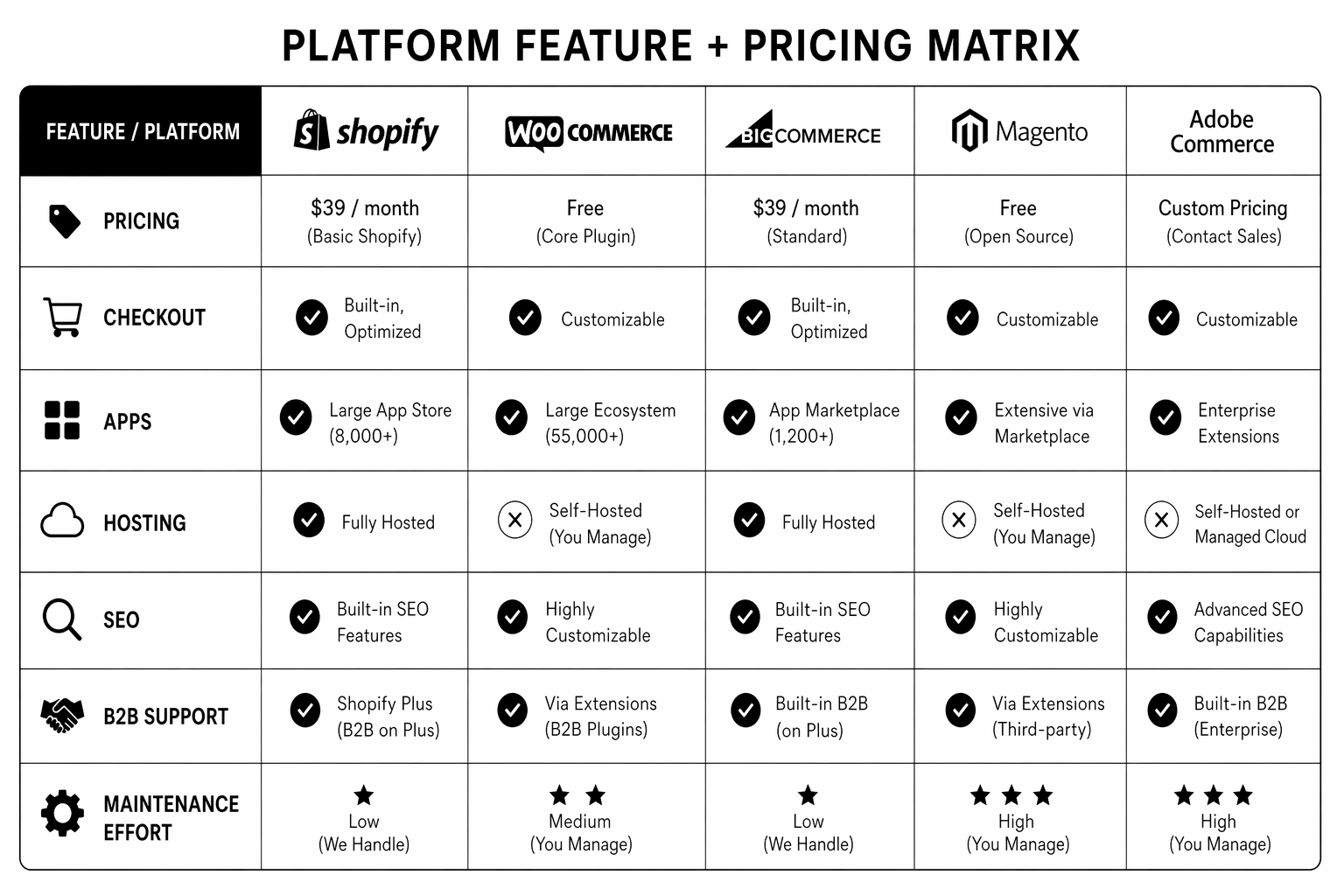
BigCommerce is often under-considered. It offers strong native capabilities for complex catalogues, multi-store needs, and B2B scenarios without as much dependency on paid apps as Shopify in some cases.
Its main challenge is ecosystem momentum: Shopify’s partner and app ecosystem still tends to move faster. For many teams, ecosystem velocity matters as much as feature parity.
Total Cost of Ownership by 36 Months
Shopify has clearer recurring costs and faster implementation for most teams. WooCommerce appears cheaper early but can become expensive once you account for managed hosting, security tooling, performance optimisation, plugin subscriptions, and developer time. BigCommerce sits between the two depending on plan and integration stack.
The question is not which monthly plan is cheapest. It is which platform delivers the best margin after operating overhead.
Need help choosing before committing to a rebuild? Our team maps platform fit by catalogue complexity, growth goals, and operations model. Book ecommerce platform advice.
SEO and Conversion Performance
All three platforms can rank and convert well. Outcomes depend on implementation quality, page speed discipline, and product page architecture. Shopify generally makes baseline performance easier. WooCommerce allows deep customisation but can degrade fast with plugin sprawl. BigCommerce is stable but may require more custom work for highly specific content workflows.
Regardless of platform, conversion growth requires structured experimentation. Use this with our CRO playbook once your build is live.
Which Platform Should You Pick in 2026?
- Pick Shopify if your priority is fast scaling with low operational friction.
- Pick WooCommerce if you truly need WordPress-level backend control and have technical depth.
- Pick BigCommerce if you need stronger native B2B/catalogue features and your team is comfortable with a smaller ecosystem.
If you are planning to hire external support either way, choose the platform your long-term partner is strongest at and can support consistently.
FAQ
Is Shopify better than WooCommerce in 2026?
For most scaling DTC brands, yes, because of speed and lower maintenance burden. WooCommerce is still excellent where custom control is the top requirement.
Is BigCommerce better for B2B ecommerce?
It can be. BigCommerce has strong native B2B capabilities that reduce reliance on paid apps for some enterprise use cases.
Which platform is cheapest long-term?
It depends on team structure. WooCommerce can be cheap with strong in-house capability. For many teams, Shopify has lower total operational cost despite higher visible subscription spend.
Can I migrate later if I choose wrong?
Yes, but migrations are expensive and risky. It is better to choose based on 3-year operating reality now than plan to migrate in 12 months.
Should I go straight to Shopify Plus?
If you have complex checkout needs, B2B/wholesale requirements, or revenue scale that justifies it, yes. Otherwise start on Shopify with a Plus-ready architecture.
Conclusion: Optimise for Operating Speed, Not Platform Hype
The best choice in Shopify vs WooCommerce vs BigCommerce is the one your team can execute on consistently under growth pressure. In 2026, that usually means Shopify for most brands, WooCommerce for high-control technical teams, and BigCommerce for specific catalogue/B2B profiles.
Make the decision on operating model and total cost, not feature-list theatre.
If you want a practical second opinion before you lock in, our Shopify development team can help pressure-test your options. Book a consultation.
The Ecommerce Platform Selection Guide
— a scoring worksheet for platform fit by complexity, margin goals, and team capability.
“