
 Website Designing
 Web Development
 Mobile Applications
 Marketing
 CMS & Ecommerce
Table of Contents
If you’re doing more than £1M ($1.25M) a year in revenue on Shopify, you should be on Shopify Plus or have a serious reason you’re not. If you’re doing more than £5M and still on standard Shopify, you’re actively leaving money on the table — in checkout customisation, throughput during launches, and automation that standard plans can’t touch.
This is a practical Shopify Plus development guide for founders, CMOs, and heads of ecommerce at DTC brands. What Plus actually gives you. What it costs. What a real build timeline looks like. And how to pick a Shopify Plus agency that won’t burn six months of your runway on a build that doesn’t move your numbers.
What Is Shopify Plus Development?
Shopify Plus is Shopify’s enterprise tier. It starts around $2,300/month (or 0.4% of revenue for larger merchants, capped at $40,000/month). What you get:
- 200 inventory locations (vs 10)
- Unlimited staff accounts
- Shopify Functions for custom checkout, discounts, delivery, and payment logic
- Shopify Flow for automation
- Launchpad for scheduled campaigns
- Wholesale / B2B channel
- Higher API limits
- Dedicated support and a Merchant Success Manager
Shopify Plus development is the work of building and extending a store to use those capabilities. It’s a different skill from standard Shopify theme work — it involves Functions, checkout extensibility, headless architecture (where appropriate), and deep app-stack integration.
Why Shopify Plus Matters in 2026
1. The checkout extensibility window is now. Shopify shut down checkout.liquid in August 2024 for Plus merchants. Brands that didn’t migrate to Checkout Extensibility lost custom upsells, trust badges, and conversion tactics overnight. In 2026, every Plus brand needs a properly extensible checkout.
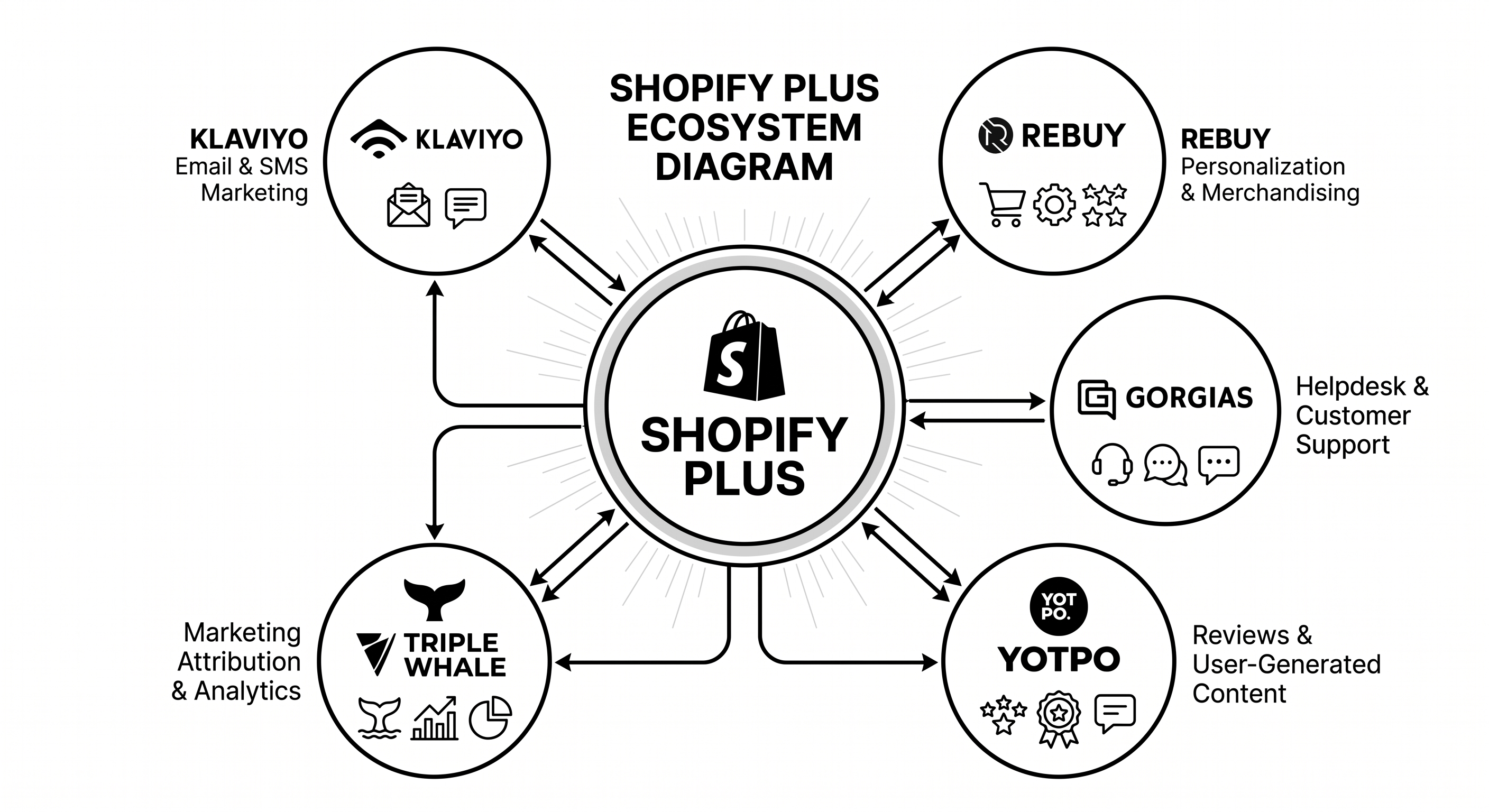
2. Apps got expensive. Mid-tier Shopify brands now spend £2k–£8k/month on apps (Klaviyo, Rebuy, Gorgias, Postscript, Yotpo, Triple Whale). Shopify Plus lets you replace a meaningful chunk of that with native Functions and Flow automations.
3. B2B is consolidating on Plus. Shopify’s B2B functionality matured significantly in 2024–25. DTC brands launching wholesale channels now use the same store instead of running Faire, separate B2B platforms, or WooCommerce side-systems.
Weighing your options? Read Shopify vs WooCommerce vs BigCommerce for the full platform comparison.
How Shopify Plus Development Works
A serious Plus build has six workstreams running in parallel.
1. Storefront
The customer-facing site. Could be Shopify’s Online Store 2.0 (Liquid-based, native) or headless (Hydrogen/Remix, Next.js, Nuxt). 80% of Plus brands should stay on OS 2.0 unless there’s a hard performance or internationalisation reason to go headless.
2. Checkout
With checkout.liquid gone, customisation happens via Checkout Extensibility — UI extensions for custom content, Functions for logic (discounts, shipping, payment). This is where conversion money is made or lost.
3. Apps and Integrations
Klaviyo for email/SMS. Gorgias for support. Triple Whale for attribution. Rebuy for post-purchase. Yotpo or Okendo for reviews. A Plus-grade build integrates these cleanly, with attribution and event data flowing correctly.
4. Shopify Functions
Custom logic that runs on Shopify’s infrastructure. “Free shipping over £150 only for subscribers.” “Loyalty tier discounts applied automatically.” “Bundle pricing without an app.” Functions replace many paid apps and run faster.
5. Shopify Flow
Automation without code. “When an order is placed above £500, tag as VIP and alert customer success.” “When a subscriber orders a non-subscription SKU three times, upsell subscription.”
6. B2B / Wholesale
Company accounts, gated catalogues, custom pricing, net-terms payment. All native in Plus.
Step-by-Step: The Plus Build Process
Phase 1 — Audit (Week 1–2). Current tech stack, checkout setup, app costs, conversion funnel, sales tax handling, international setup. Output: findings doc + prioritised roadmap.
Phase 2 — Design (Week 3–5). Figma designs for home, collection, product detail, cart, and key landing pages. Mobile-first. Design system documented.
Phase 3 — Development (Week 6–10). Theme build on OS 2.0, metaobject-driven content, Functions and Flow built, app stack configured, checkout extensions built.
Phase 4 — QA + Migration (Week 11–12). Product data integrity, customer migration, order history, redirects, tax settings, shipping zones.
Phase 5 — Launch + CRO (Week 12+). Launch, 14-day monitoring, then a rolling conversion rate optimization programme. The build is never “done” — it enters optimisation mode.
Running Plus and not sure where the money is hiding? Our Shopify Plus team runs a free 45-minute store teardown — we’ll show you the three highest-ROI fixes specific to your store, no pitch. Book it here.
Best Tools and Stack for Shopify Plus in 2026
- Klaviyo — Email + SMS, still the category leader for DTC.
- Gorgias — Customer support; integrates with Shopify order data cleanly.
- Triple Whale — Post-iOS 14 attribution. Required for any brand spending on Meta/Google.
- Rebuy — Post-purchase upsells, smart cart.
- Okendo or Yotpo — Reviews, UGC.
- Loop — Returns automation that actually reduces cost per return.
- Recharge or Skio — Subscription (if applicable).
- Fera or Judge.me — Alternative review apps for smaller brands.
- Searchanise or Algolia — On-site search when native isn’t enough.
Our Shopify development team configures this stack for clients constantly.
Common Shopify Plus Mistakes
1. Overbuilding headless when OS 2.0 would work. Headless costs 3x more to build and maintain. Only justify it with real reasons: extreme performance, complex internationalisation, or custom frontend requirements OS 2.0 can’t meet.
2. Ignoring checkout extensibility migration. Still running old checkout.liquid code? Conversion tactics are silently breaking. Fix now.
3. App bloat. 40+ apps installed, half unused, all loading scripts. Audit quarterly. Kill apps that don’t tie directly to revenue.
4. Weak product data architecture. Metafields used inconsistently. Product copy scattered. Fix: metaobjects + documented metafield schema from day one.
5. No CRO programme post-launch. Brand spends £80k on a build, treats it as finished. Lift from a structured CRO programme post-launch usually outweighs the original build cost within 12 months. See Shopify conversion rate optimization for the playbook.
FAQ
Who should actually be on Shopify Plus?
Brands doing £1M+ in revenue, brands running B2B/wholesale, brands with complex discount logic, brands needing custom checkout, brands with international markets. If none of these apply, standard Shopify Advanced may be enough.
How much does a Shopify Plus development project cost?
Typical: £30k–£120k / $40k–$150k for a full build. Migration projects cost more. Ongoing retainers for CRO and development support run £5k–£20k/month.
How long does a Plus build take?
8–14 weeks for a new theme on OS 2.0. 12–20 weeks for a migration from WooCommerce or Magento. Headless builds run 16–28 weeks.
Is headless Shopify worth it?
For most DTC brands, no. For brands with custom frontend requirements, extreme performance needs, or complex multi-region setups, yes. Don’t let an agency upsell you headless unless they can name three specific reasons it’s required.
Can I migrate from Shopify to Shopify Plus without losing data?
Yes — it’s the same platform, just a tier change. Upgrade is mostly a commercial and feature-unlock change, not a technical migration.
Conclusion: Plus Rewards Brands That Build It Right
Shopify Plus is a commercial platform, not just a technical one. Brands that treat it as “same Shopify, bigger plan” leave the platform’s real value untouched. Brands that treat it as an ecommerce infrastructure investment — custom checkout, Functions, B2B, automation — see compounding returns inside two quarters.
If you’re evaluating a Plus build, migration, or rebuild, the single biggest predictor of success is the agency you pick. Before you sign anything, talk to our Shopify Plus team — 45-minute call, we’ll review your current stack and map what a realistic build or rebuild should look like for your brand.
The Shopify Plus Scoping Workbook
— 20-page Notion template covering tech audit, app stack review, checkout extensibility mapping, and build prioritisation.