Tag Archives: growth

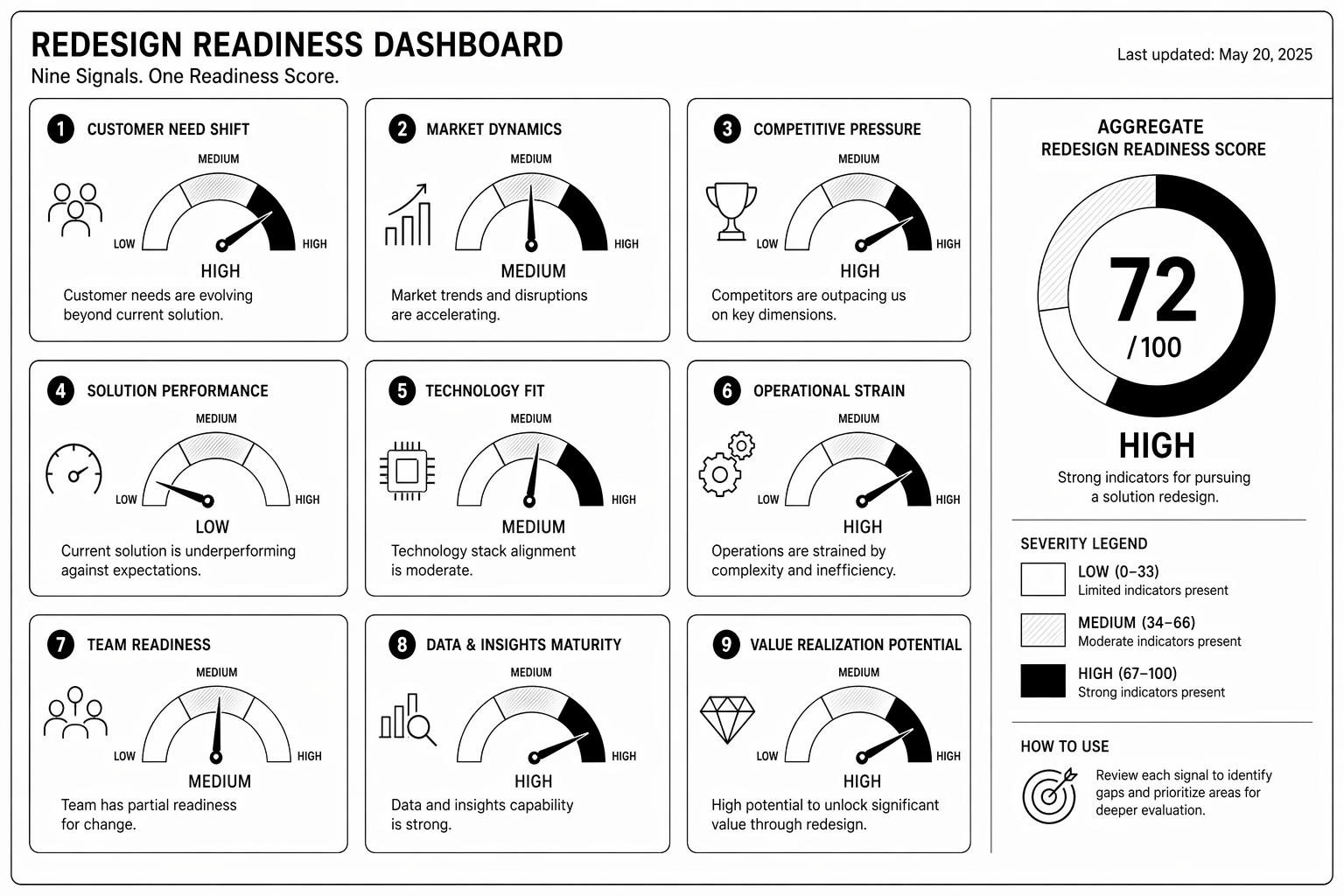
When Should You Redesign Your Website? 9 Clear Signals

Most companies wait too long to redesign. They know the site is tired, but they’re not sure if the time is now or later. Result: six more months of lost traffic, low conversions, and executive frustration that could have been avoided with a decision framework.

This guide covers the 9 clear signals that a redesign is overdue, the framework to choose between refresh vs redesign vs rebuild, and how to prioritise redesign in your roadmap.

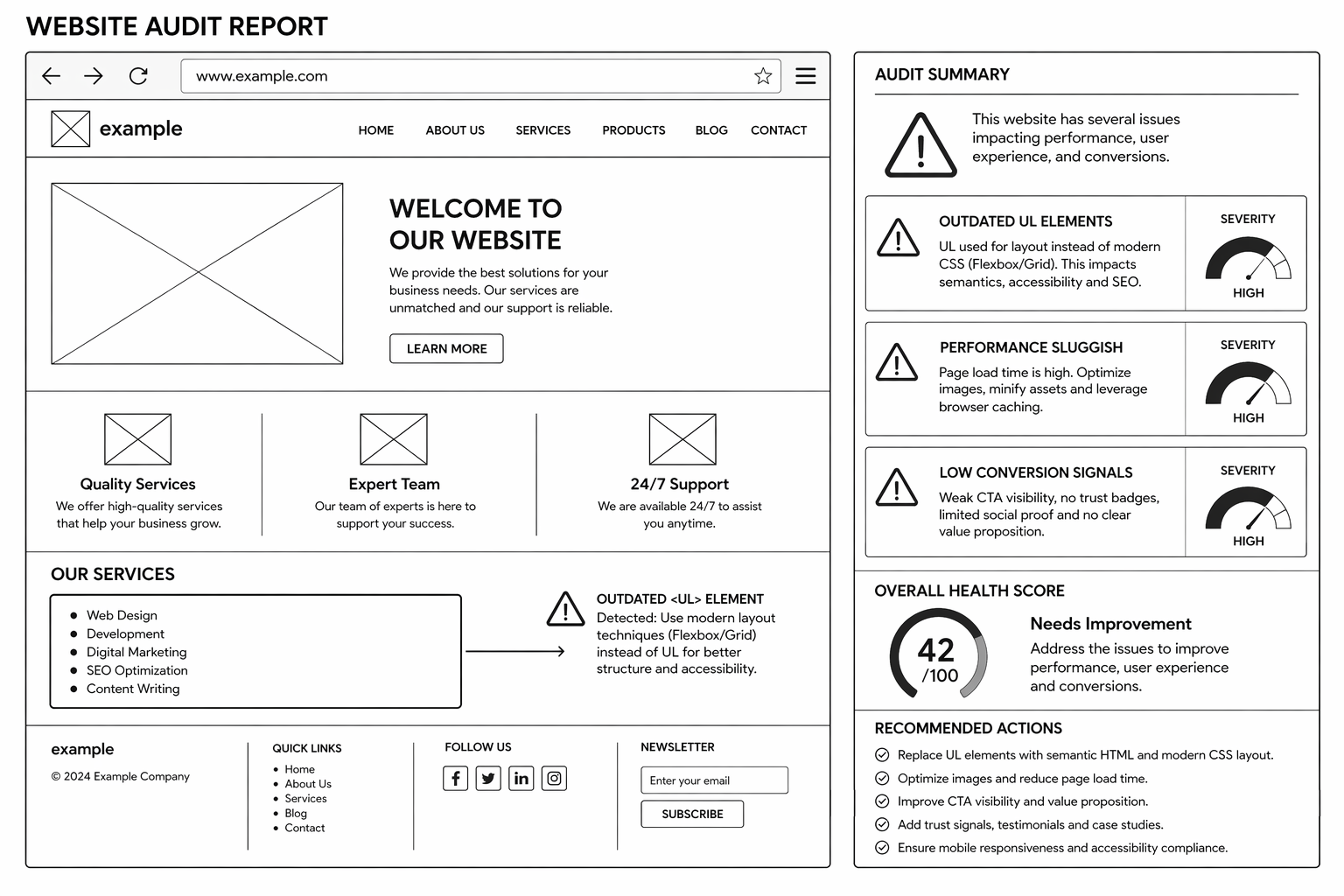
The 9 Signals Your Website Needs a Redesign

1. Organic traffic has plateaued or declined for 6+ months. If traffic isn’t growing despite increased content and backlinks, the site itself may be the ceiling. Sites over three years old often need architecture refresh.

2. Core Web Vitals are red (especially INP or CLS). Your site is slow, janky, or unstable on mobile. Google sees it, so do visitors. Redesign is the reset button.

3. Conversion rate is 30%+ below your category benchmark. If demo request rate or lead conversion is substantially worse than competitors, messaging, design, or tech architecture is wrong.

4. Bounce rate is above 60% on key pages. Visitors land, see outdated design or unclear value prop, leave immediately. Redesign won’t fix bad positioning, but it removes design as the objection.

5. Mobile conversion is 50%+ lower than desktop. Site wasn’t designed mobile-first. Responsive fix is a patch. True mobile optimization requires redesign.

6. Design no longer matches current brand or product. Last redesign was 3–4 years ago. Brand has evolved. Site looks like an old company.

7. Marketing team says “we can’t get anything shipped.” CMS is slow, editing is painful, approval workflows are broken. Operations problem, usually solved by platform migration.

8. You’ve added so many feature requests the site feels bloated. Homepage is 5,000px long. Navigation has 40+ items. Information architecture broke under weight of feature creep.

9. Support team logs 20+ tickets/month about the site. UX confusion, forms breaking, checkout issues. Users are telling you the site is broken before analytics do.

Refresh vs Redesign vs Rebuild: The Decision Framework

Refresh (4–8 weeks, £5k–20k):

  • Brand colours, fonts, imagery updated.
  • Same CMS, same platform, same IA.
  • No structural changes.
  • Choose this if: Brand is tired but strategy is sound. Content performs well. No major platform complaints.

Redesign (10–16 weeks, £20k–60k):

  • New visual design + IA rethink + CMS optimisation.
  • Same platform (usually) but restructured content.
  • CRO-focused changes.
  • Choose this if: Signals 1–5 above are present. Information architecture is broken but strategy is sound.

Rebuild (16–24 weeks, £60k–150k+):

  • New platform entirely or complete technical rewrite.
  • New strategy, new positioning, new IA.
  • Everything changes.
  • Choose this if: Platform is actively hurting growth. Multiple signals present. Need major strategic reset.
Timing: When to Start Planning

Start planning immediately if: 3+ signals are present. Planning takes 4–8 weeks. You want the redesign live before your busiest season.

Start planning within 90 days if: 1–2 signals are present but trending worse. Monitor. If it gets to 3, accelerate.

Wait if: No signals present, site is performing well, team is happy. Don’t redesign for the sake of redesign.

Unsure if your site needs a redesign? Our team runs free 30-minute readiness assessments. Book one and we’ll tell you honestly whether refresh, redesign, or rebuild is right.

Common Mistakes When Deciding to Redesign

1. Redesigning without understanding why traffic slowed. Redesign is a potential solution, not the solution. Audit first.

2. “Let’s refresh the design” when the problem is information architecture. Pretty site with bad IA still doesn’t convert.

3. Redesigning too often. Every two years is expensive and demoralising. Every four years is standard. Refresh between redesigns.

4. Redesigning during peak season. Launch during slow periods. January, April, September are safer than Black Friday or product launch season.

5. No baseline metrics before redesign. You won’t know if it worked. Capture traffic, conversions, and performance before launch.

For the actual redesign process, see our complete redesign guide to protect SEO and execution quality.

FAQ

How often should I redesign my website?

Every 3–4 years for major redesigns. Refresh between redesigns annually or every two years. Continuous small iterations always beat big periodic overhauls.

Should I redesign during growth season?

No. Launch during off-season (Q1 or Q3 for most B2B). You need 4–6 weeks post-launch to monitor and fix issues without impacting revenue.

Can I redesign gradually or do I need a hard cutover?

Hard cutover is cleaner SEO-wise. Gradual rollouts are messier redirect-wise. Pick one or the other, avoid in-between.

Will a redesign hurt my SEO?

Only with bad execution. Proper 301 redirects, content parity, and metadata preservation keep rankings intact. See the redesign SEO guide.

What’s the simplest signal I should redesign?

If your site is over four years old and you haven’t refreshed design or IA, that’s reason enough. Design trends change. User expectations change. Your site should reflect current reality.

Conclusion: Redesign When Multiple Signals Align

Don’t redesign on a hunch or trend alone. Use this signal framework. If 3+ signals are present, redesign is likely overdue. If 1–2 signals are present, monitor and plan for the next quarter.

Start planning early. Launch during off-season. Measure baselines before and after. You’ll know within 90 days if redesign was worth it.

Our redesign team runs readiness audits and execution. Book a consultation if you’re on the fence.

📥 Free resource: The Redesign Readiness Self-Assessment — a worksheet to score your site against the 9 signals and get a clear recommendation.
That's enough scrolling for now - chat to a HubSpot expert today!
Contact Us
SaaS Website Growth Strategy: Turn Your Site Into a Lead Engine

Most SaaS marketing sites are digital brochures. Beautiful, yes. Strategic? No. They sit at the top of the funnel, generate a few qualified leads per month, then rely on paid ads and outbound to fill pipeline.

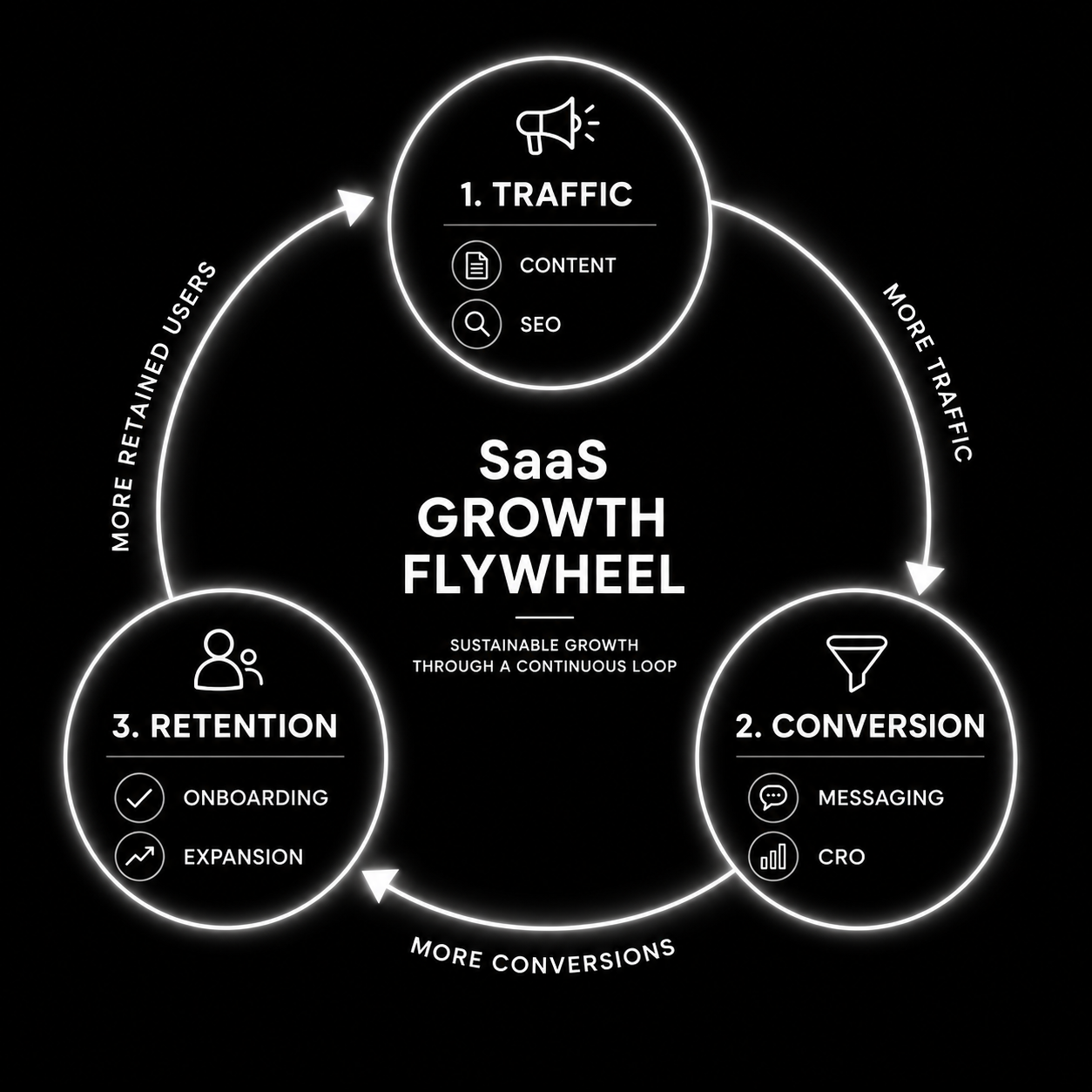
The top 10% of SaaS websites are built as compounding systems. Content attracts organic traffic. Layout and copy convert visitors to qualified leads. Onboarding and activation convert trials to paying customers. Each loop feeds the next. Year-over-year, the machine gets more efficient, not less.

This guide covers how to shift your site from brochure to lead engine. The three loops. The metrics that matter. How to prioritise.

The Three Loops of a SaaS Growth Flywheel

Loop 1: Traffic Loop (Content + SEO)

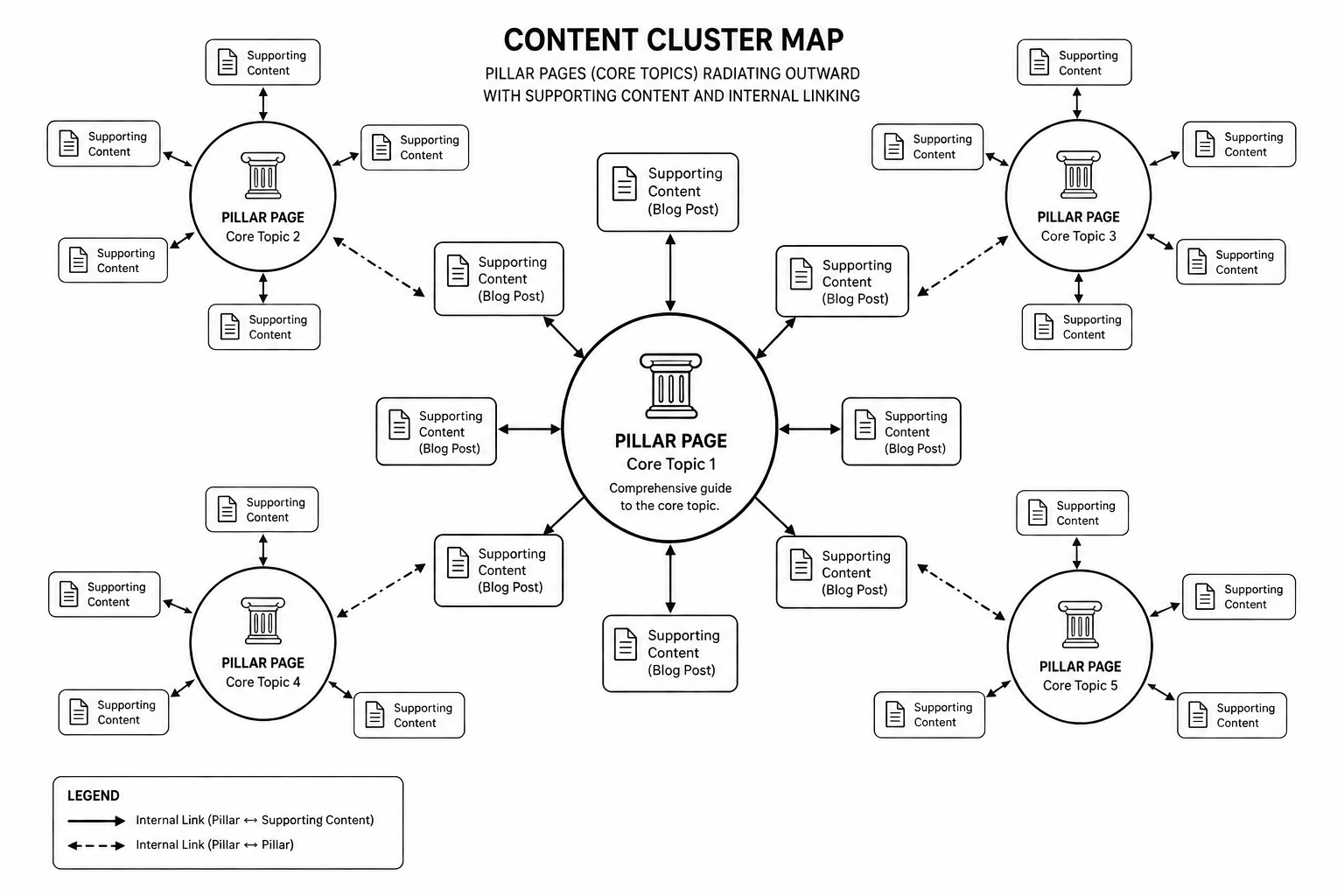
Publish topical content clusters around primary keywords. Each blog post links to product pages. Each product page links to related blogs. Internal link structure compounds. Organic traffic grows month-over-month without paid spend.

Metrics: +10–20% organic traffic per quarter is achievable with consistent content. Better if you’re starting from low baseline.

Tools: Semrush, Ahrefs for keyword research. Content management system with editorial SEO tools. See our CRO playbook for content strategy.

Loop 2: Conversion Loop (Messaging + CRO)

Visitors arrive. Layout, copy, and CTA clarity convert them to qualified leads. Not all traffic is equal. Organic traffic from high-intent keywords converts 3–5x better than paid traffic from cold audiences.

Metrics: +0.5–2% conversion rate improvement per quarter is achievable. Compounded over 12 months, that’s 20–30% lifetime improvement.

Tools: Hotjar or Clarity for session recording. Figma for design iteration. Analytics tools to segment traffic by source and intent.

Loop 3: Retention Loop (Onboarding + Expansion)

Customer signs up. Onboarding and activation direct them to first value. Early success triggers expansion moment. Existing customer reaches for upsell. Customer lifetime value increases. Word-of-mouth and referrals bring inbound interest.

Metrics: +10% retention month-over-month on a cohort. +5–10% expansion revenue per paying customer annually. 20–30% of new customers from referral/word-of-mouth.

Tools: Product analytics (Amplitude, Mixpanel). Email marketing (HubSpot, Klaviyo) for lifecycle campaigns. In-product messaging (Appcues, Userpilot) for onboarding nudges.

The Three-Phase Roadmap

Phase 1 (Months 1–3): Foundation

  • Audit current website. What converts? What doesn’t?
  • Lock positioning and messaging. Consensus on value prop.
  • Build content calendar for 12 months (pillar + supporting content).
  • Implement basic CRO (form field reduction, CTA clarity).

Phase 2 (Months 4–9): Acceleration

  • Publish 8–12 high-quality posts (one per week).
  • Build content cluster linking structure.
  • Ship 3–5 CRO experiments per month.
  • Instrument product for onboarding + conversion tracking.

Phase 3 (Months 10–12): Compounding

  • Content traffic reaches 50%+ of total visits.
  • Conversion rate improved 20–30% from baseline.
  • Onboarding and expansion workflows live.
  • Referral loop producing 15–25% of new customers.

Common Mistakes That Slow Growth Loops

1. No content strategy. Publishing randomly doesn’t build traffic. Fix: pillar/cluster strategy with 12-month roadmap.

2. Slow CRO iteration. One A/B test per quarter doesn’t move numbers. Fix: 3–5 experiments per month, measure ruthlessly.

3. Product not optimised for conversion. Website drives leads. Product doesn’t activate them. Onboarding leaks 40%. Fix: instrument product, run onboarding experiments.

4. No expansion motion. Customer signs up, gets value, stays flat. No upsell, no expansion, no referral trigger. Fix: map expansion workflow, ship lifecycle campaigns.

5. Paid ads as a crutch. Heavy paid ad spend masks broken organic. Fix: organic foundation first, paid as accelerant later.

For the full conversion optimization playbook, see the CRO playbook. For SaaS landing page specifics, see SaaS landing page optimization.

Ready to build a SaaS growth flywheel? Our growth strategy team maps the three loops for your business and prioritises Phase 1. Book a strategy call.

FAQ

What’s a realistic timeline to see results from a growth flywheel?

Phase 1 (foundation): 3 months, minimal visible change. Phase 2 (acceleration): 6 months, 2–3x traffic improvement and 20% conversion lift. Phase 3 (compounding): 12+ months, 10x traffic, 3x leads, real referral engine.

Should I hire an agency for this or do it in-house?

Hybrid works best: agency builds strategy and trains team, team executes and iterates. Pure in-house works if you have content + CRO + product analytics depth. Pure agency usually costs more and moves slower.

What’s the fastest way to see results?

Conversion optimization (Loop 2). A 2% conversion rate improvement shows in the same month. Content (Loop 1) takes 3–6 months to show. Start with quick CRO wins while content seasons.

How do I measure if my growth flywheel is working?

Track monthly: organic traffic, demo requests, qualified leads, trial signups, paying customers, LTV. You should see each increase 15–25% month-over-month if loops are tight.

Can I build a growth flywheel without a dedicated content team?

Yes, if you repurpose founder/product leader content and outsource writing. But consistency matters. One post per week beats five posts per month. Sustainable pace beats sporadic output.

Conclusion: Flywheels Beat Ad Spend

The SaaS companies growing fastest in 2026 aren’t the ones with the biggest ad budgets. They’re the ones with the tightest flywheels. Content attracts. Conversion takes. Product activates. Expansion drives. Loop repeats. More efficient every cycle.

Build the flywheel. It takes 12 months. By month 18, you have a customer acquisition machine that works with zero paid ads.

Our growth strategy team builds SaaS flywheels. Book a strategy call if you want expert roadmapping.

📥 Free resource: The SaaS Website Growth Playbook — the full 90-day roadmap for launching your three-loop flywheel with content, CRO, and onboarding milestones.

That's enough scrolling for now - chat to a HubSpot expert today!
Contact Us
Conversion Rate Optimization: The Complete 2026 Playbook

Most conversion rate optimization content you’ll read this year is a reheat of 2019 tactics. “Add urgency.” “Use exit-intent popups.” “A/B test the button colour.” If any of that still moved numbers on your site, you wouldn’t be reading this.

This is the honest 2026 CRO playbook — frameworks, prioritisation, and specific tests that work on modern SaaS and ecommerce sites where buyers are skeptical, privacy-aware, and have seen every trick. Written for marketing leaders, growth heads, and founders responsible for conversion targets.

What CRO Actually Is in 2026

CRO is the discipline of systematically increasing the percentage of visitors who take a desired action — demo request, signup, checkout, subscription. In 2026, that definition sits on top of three shifts that redefine how the work is done:

  • Attribution is broken, so CRO relies more on on-site behaviour and less on channel-level lift.
  • Buyers are saturated, so persuasion tactics that felt clever in 2019 now feel like manipulation and repel.
  • LLMs are in the research path, so buyers arrive to your landing page already primed — meaning your page has to deliver the specific answer they came for, not introduce the problem.

The practical result: modern CRO is less about UI tricks and more about clarity, specificity, and trust. Conversion rate optimization is now a positioning and content problem as much as a design problem.

Why CRO Matters More in 2026 Than Ever

1. Paid CAC keeps climbing. Meta and Google CPMs are up 20–40% over 2024 in most verticals. The only defensible response is to convert a higher share of the traffic you already buy. Every 0.5-point conversion lift pays for a quarter of CRO investment.

2. Organic traffic is getting noisier, not more qualified. AI overviews are skimming top-of-funnel answers, so the visitors who do land on your site are later in the buying process and more price-aware. They need faster, sharper conversion paths.

3. SaaS retention is a conversion problem now. Activation, expansion, and upgrade are all conversion events. Modern CRO programmes run across the whole lifecycle, not just the marketing site.

If you’re running Shopify, pair this with our Shopify CRO tactics. If you’re SaaS, see SaaS landing page optimization.

How a Real CRO Programme Works

Every credible CRO programme runs on the same four-part loop. Teams that skip any of the four produce noise, not lift.

1. Research

Analytics, session replay, on-page surveys, user interviews, funnel analysis, competitor teardowns. Output: a list of specific friction points with evidence, not opinions.

2. Hypothesis

Every test gets a written hypothesis: “Because [evidence], we believe [change] will cause [specific metric] to [direction] by [amount].” If you can’t write this in one sentence, you’re not ready to test.

3. Experiment

Design, build, QA, launch, monitor. Sample size calculated in advance. No peeking and stopping early. Test runs for full business cycles, not random durations.

4. Decide + Ship

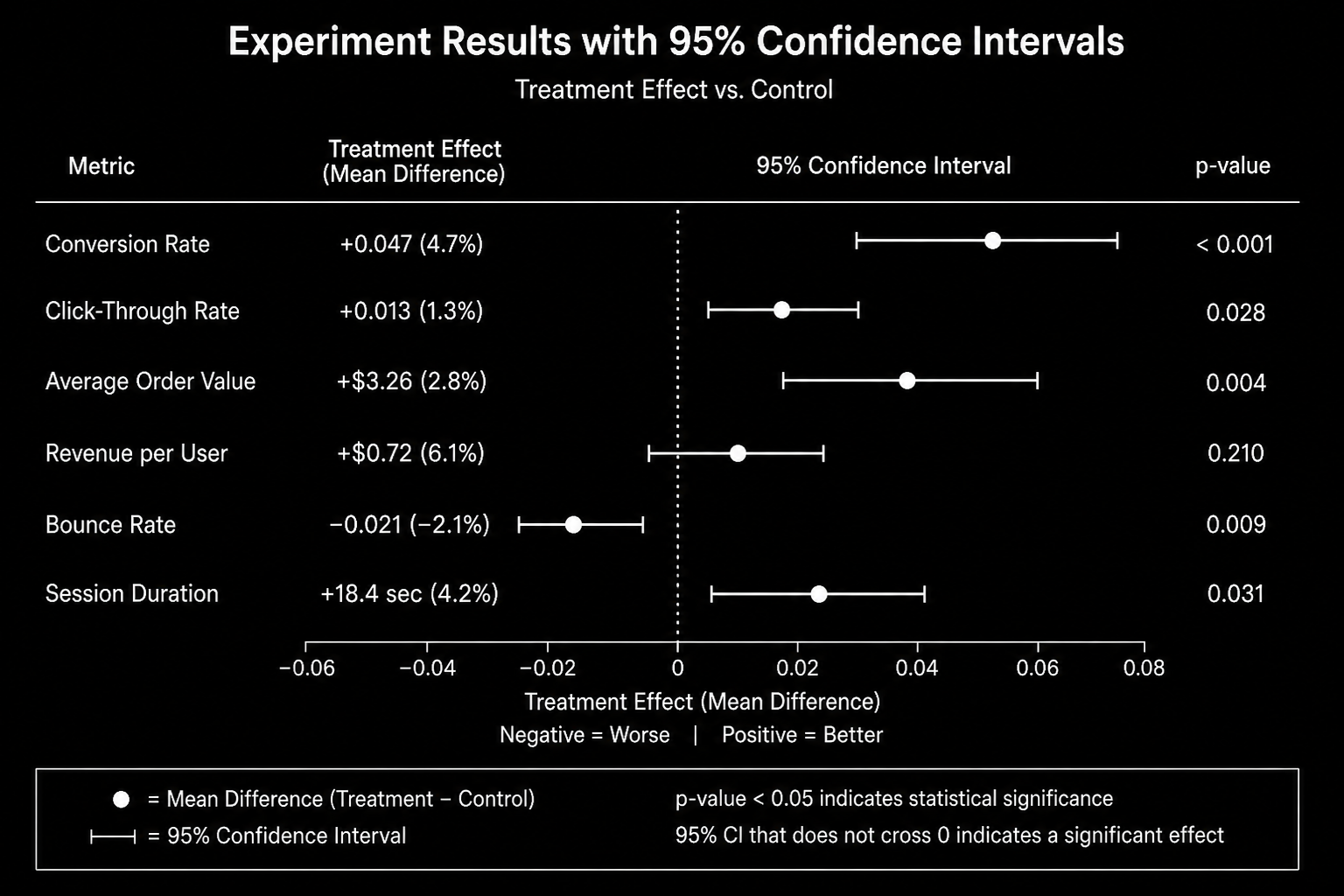
Statistical significance reviewed. Winner shipped or losing variant killed. Learnings logged in a knowledge base. Next experiment primed.

Step-by-Step: Building a CRO Programme That Ships Lift Every Month

Step 1 — Instrument properly. Analytics setup audit. Event tracking on every meaningful action. Session replay on key pages. Surveys on intent-signal pages. If your data is dirty, every test result is wrong.

Step 2 — Map conversion baselines. 30-day baseline on every key metric before changing anything. Without this, you can’t defend wins to the CFO.

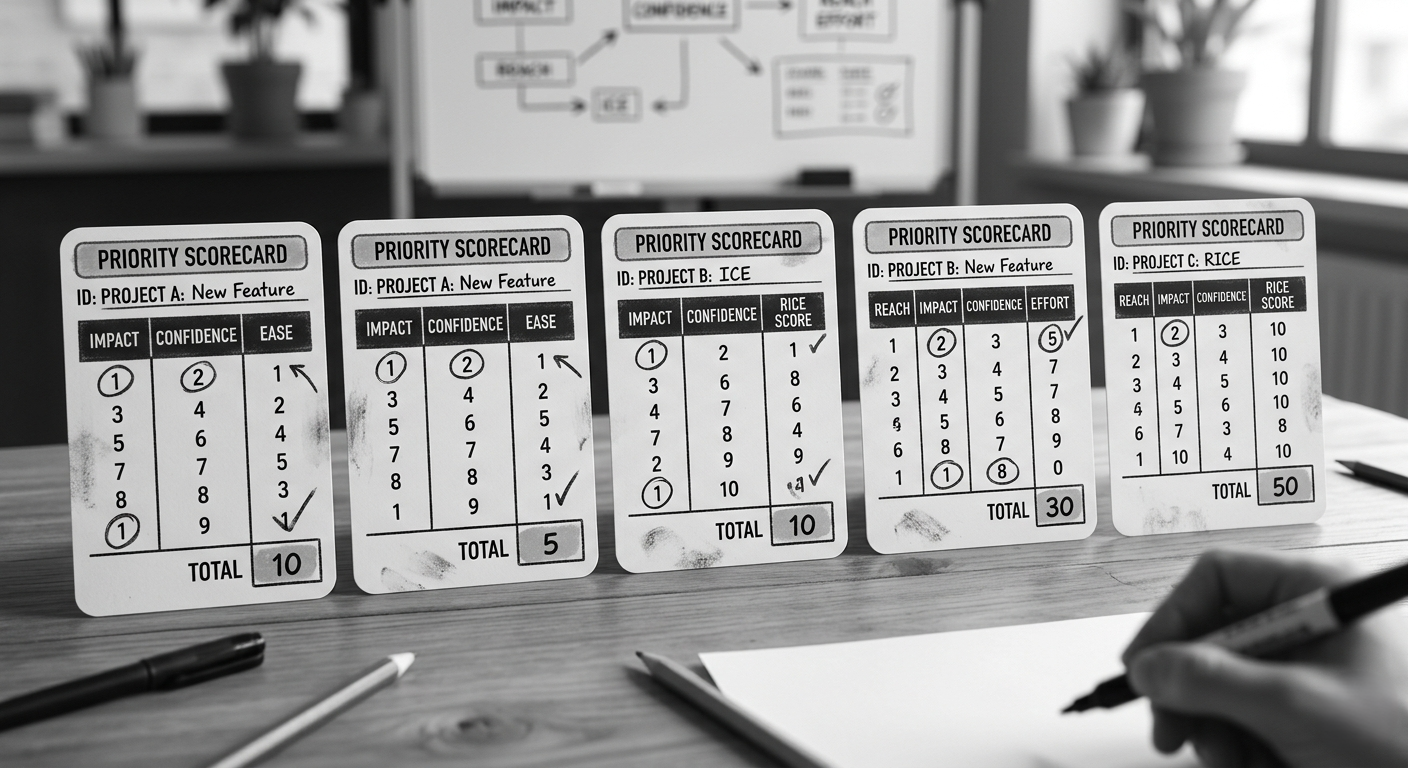
Step 3 — Build a prioritised backlog. Use ICE or RICE. Don’t test everything. Test the experiments with highest expected value first.

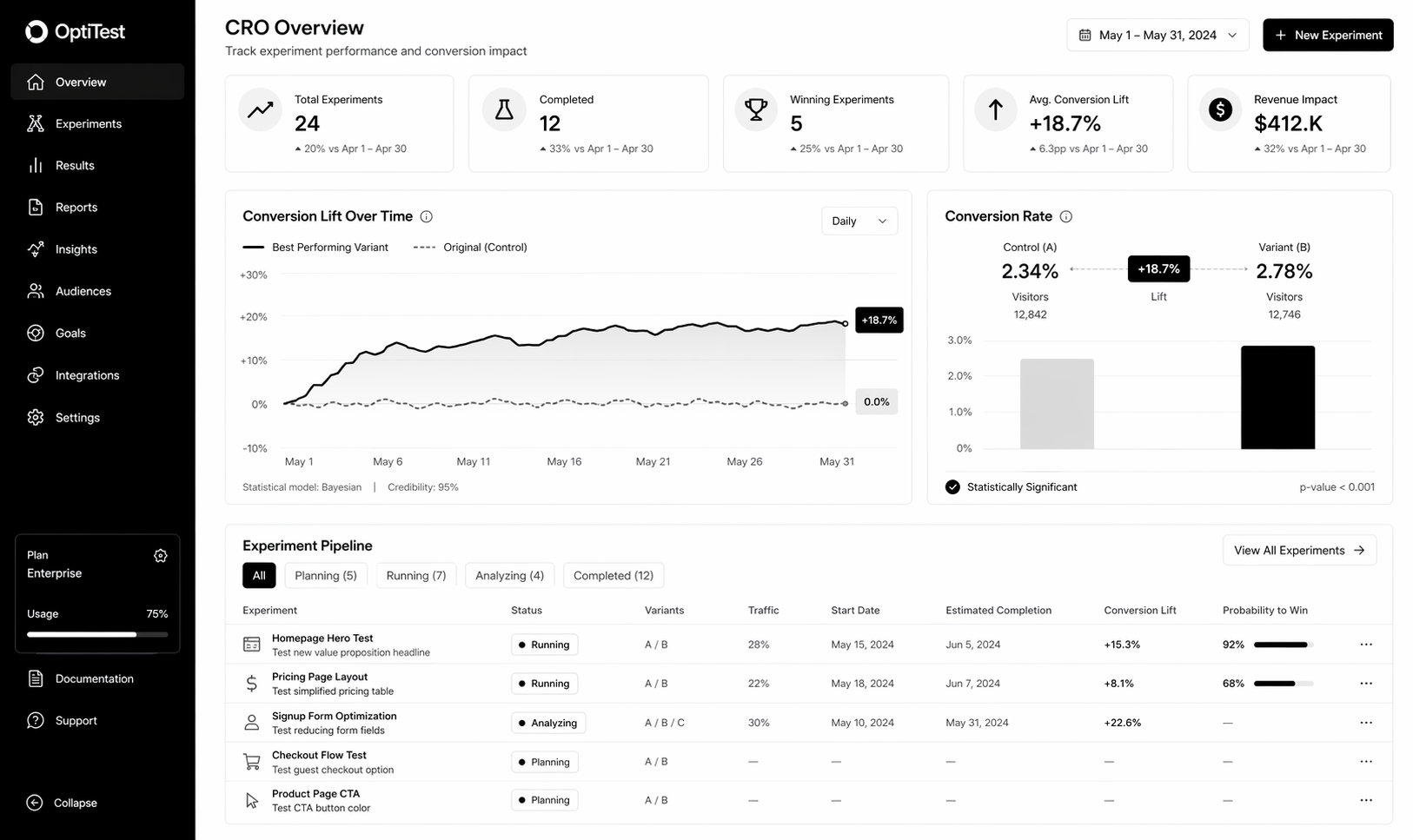
Step 4 — Ship tests weekly. Smaller, faster experiments beat huge quarterly overhauls. Ship 3–5 tests per month on a healthy site.

Step 5 — Compound learnings. Losing tests teach more than winning tests. Every experiment’s insight goes into a shared knowledge base.

Step 6 — Ladder up to structural changes. When the same pattern (e.g. pricing confusion) keeps losing tests, it’s not a test problem — it’s a positioning or product problem. CRO points at structural issues; structural fixes multiply the lift.

Running a site that’s converting below your category benchmark? We run free 60-minute CRO audits for SaaS and ecommerce brands. Book a CRO strategy session — we’ll show you the three experiments most likely to move your numbers this quarter.

The CRO Tests That Actually Work in 2026

Not a generic list. These are the experiment categories that consistently return lift in 2026 for B2B and ecommerce sites we run programmes on.

  • Hero clarity test — Replace clever taglines with a specific, mechanism-led value prop. “We do X for Y so you get Z.” Almost always wins against vague brand copy.
  • Social proof stack test — Add quantified, named customer logos + one specific result above the fold. Generic “trusted by 500+ companies” is now ignored.
  • Friction audit on forms — Cut one field at a time, measure completion rate. Most B2B forms have 2–3 fields that don’t need to be there.
  • Pricing page structure — Prospects bounce when pricing forces them to calculate. Test: add a recommended tier highlighted, add comparison rows, add calculator.
  • Objection-handling blocks — Dedicated section near the CTA answering the 3 most common objections your sales team hears.
  • CTA specificity — “Book demo” vs “See pricing” vs “Get 15-min walkthrough.” Intent-aware CTAs routinely lift click-through 20–40%.
  • Case study injection — A customer result card placed mid-page near the CTA, not hidden on a customer page nobody visits.
  • Lifecycle-aware content — On HubSpot, smart content for known vs unknown visitors. Returning customers shouldn’t see “Book a demo.”

Best Tools for CRO in 2026

  • VWO or Optimizely — Enterprise-grade experimentation platforms. Split.io for feature-flag-driven testing.
  • GrowthBook (open source) — Self-hosted experimentation, increasingly popular with engineering-led teams.
  • Hotjar, Microsoft Clarity, FullStory — Session replay + heatmaps. Clarity is free and surprisingly good.
  • Mixpanel / Amplitude — Product-led CRO for SaaS activation and expansion funnels.
  • HubSpot A/B testing — Native for teams already on CMS Hub Professional. See our HubSpot development team’s setup guide.
  • Shopify experiments or Intelligems — Ecommerce testing with conversion and revenue tracking.
  • Unbounce or Instapage — For paid landing page testing without a developer.
  • Typeform or Sprig — On-site surveys and qualitative research.

Common CRO Mistakes

1. Testing button colours. Rounding error. Stop. Test copy, structure, offer.

2. Peeking at results and stopping early. Tests stopped before significance are guessing, not science. Run full duration.

3. No research before testing. Teams pick tests off Twitter. Zero relevance to their site. Fix: research first, hypothesis second, test third.

4. Running tests on low-traffic pages. Not enough sample to reach significance. Fix: run tests on your highest-traffic pages first.

5. No learning repository. Same losing tests re-run every 18 months because nobody remembers. Fix: document every test + outcome in a shared Notion or Airtable.

6. Treating design as the only variable. The biggest conversion lifts come from positioning, pricing, and offer — not design polish. If your website redesign didn’t change what you say, it probably won’t change conversion either.

FAQ

What’s a good conversion rate in 2026?

Benchmark depends on vertical. B2B SaaS marketing site to demo: 2–4%. Ecommerce DTC: 2.5–4%. High-ticket B2B: 0.5–2%. Good is relative to your history and category median — not a universal number.

How long should a CRO test run?

Until you hit a pre-calculated sample size AND at least one full business cycle (usually 2 weeks minimum). Anything shorter is noise.

How much does a CRO programme cost?

In-house: 1–2 headcount plus tooling (£50–150k/year). Agency retainer: £5–20k/month depending on scope. For most mid-market businesses, a specialist CRO agency returns faster than hiring in-house for the first 12 months.

How soon should we see results?

First test in 2–3 weeks. First meaningful win typically within 6–8 weeks. Compounding lift from 3–5 wins usually shows in quarterly numbers by month 4–6.

Do I need a dedicated CRO agency, or can my web agency do it?

Most web agencies design and build. CRO is a different discipline — it’s experimentation, statistics, and behavioural research. A good agency will either have a dedicated CRO team or partner with one.

Conclusion: CRO as a Compounding System

The brands with the best conversion rates in 2026 didn’t get there by running one test. They built a programme that ships five well-researched experiments a month, logs every learning, and compounds lift quarter over quarter.

If your current CRO effort is sporadic — test when we remember, ship when it wins — you’re leaving money on the table every month. The system beats the sprint.

Our team runs CRO programmes for SaaS and ecommerce brands in the UK and USA. If you want to see where your site is leaving conversion on the table, book a free CRO strategy session — 60 minutes, we’ll walk through your analytics and map the three tests most likely to move your numbers this quarter.

📥 Free resource: The CRO Experiment Backlog Template — the Notion template we use to score, prioritise, and track every experiment across a 90-day programme.

That's enough scrolling for now - chat to a HubSpot expert today!
Contact Us
DTC Ecommerce Growth Playbook: 14 Levers That Compound in 2026

DTC Ecommerce Growth Playbook in 2026 is won by execution quality, not platform hype. Teams that perform consistently align strategy, implementation, and measurement into one operating system. This guide gives the practical framework, internal link map, and optimization cadence to do that.

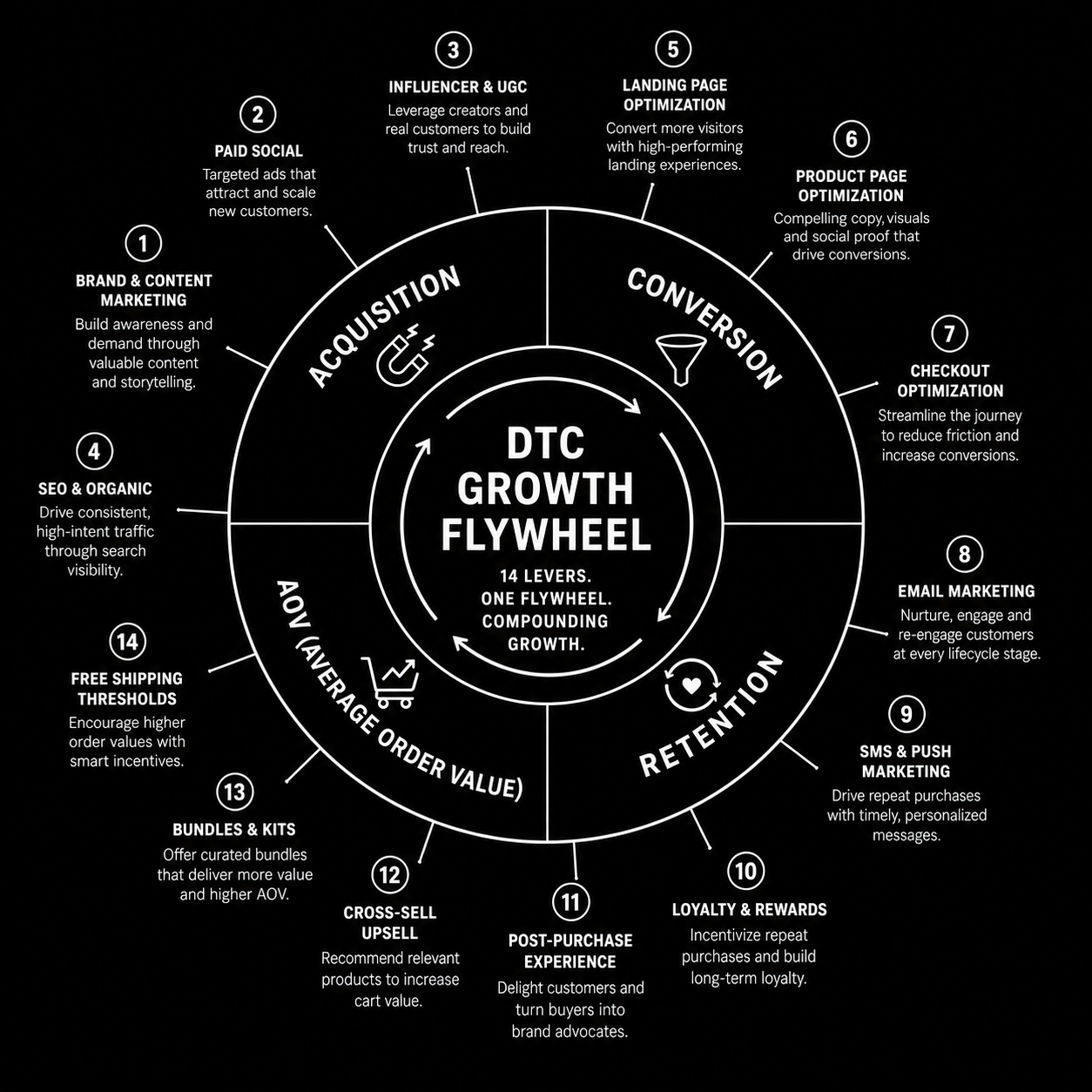
DTC growth in 2026 isn’t a single channel — it’s 14 levers compounding. Here’s the playbook that works. If you want implementation help, work with our Shopify developers. For connected strategy, also review Shopify Plus Development Guide and Shopify Conversion Rate Optimization.

What DTC Ecommerce Growth Playbook Means in Practice

DTC ecommerce growth is a compounding system across acquisition, conversion, retention, and AOV. The strongest brands avoid single-channel dependence and run an integrated growth flywheel.

Why dtc ecommerce growth Matters in 2026

1. Paid channel volatility makes one-channel strategies fragile.

2. Retention quality now drives profitability more than traffic volume.

3. Winning teams iterate quickly across offers, creative, and lifecycle mechanics.

Step-by-Step Playbook

1. Audit growth mix

Quantify channel contribution and margin impact.

2. Pick highest-leverage constraint

Fix one bottleneck at a time for compounding gains.

3. Improve merchandising strategy

Align bundles and offers to margin-aware demand signals.

4. Expand retention automations

Improve post-purchase, replenishment, and win-back flows.

5. Review flywheel monthly

Track how changes in one lever affect the whole system.

Mid-article CTA -> Need support applying this to your stack? DTC growth audit and get a scoped roadmap with timeline, owners, and KPI targets.

Tools, References, and Benchmarks

  • 14-lever growth map
  • Channel contribution scorecard
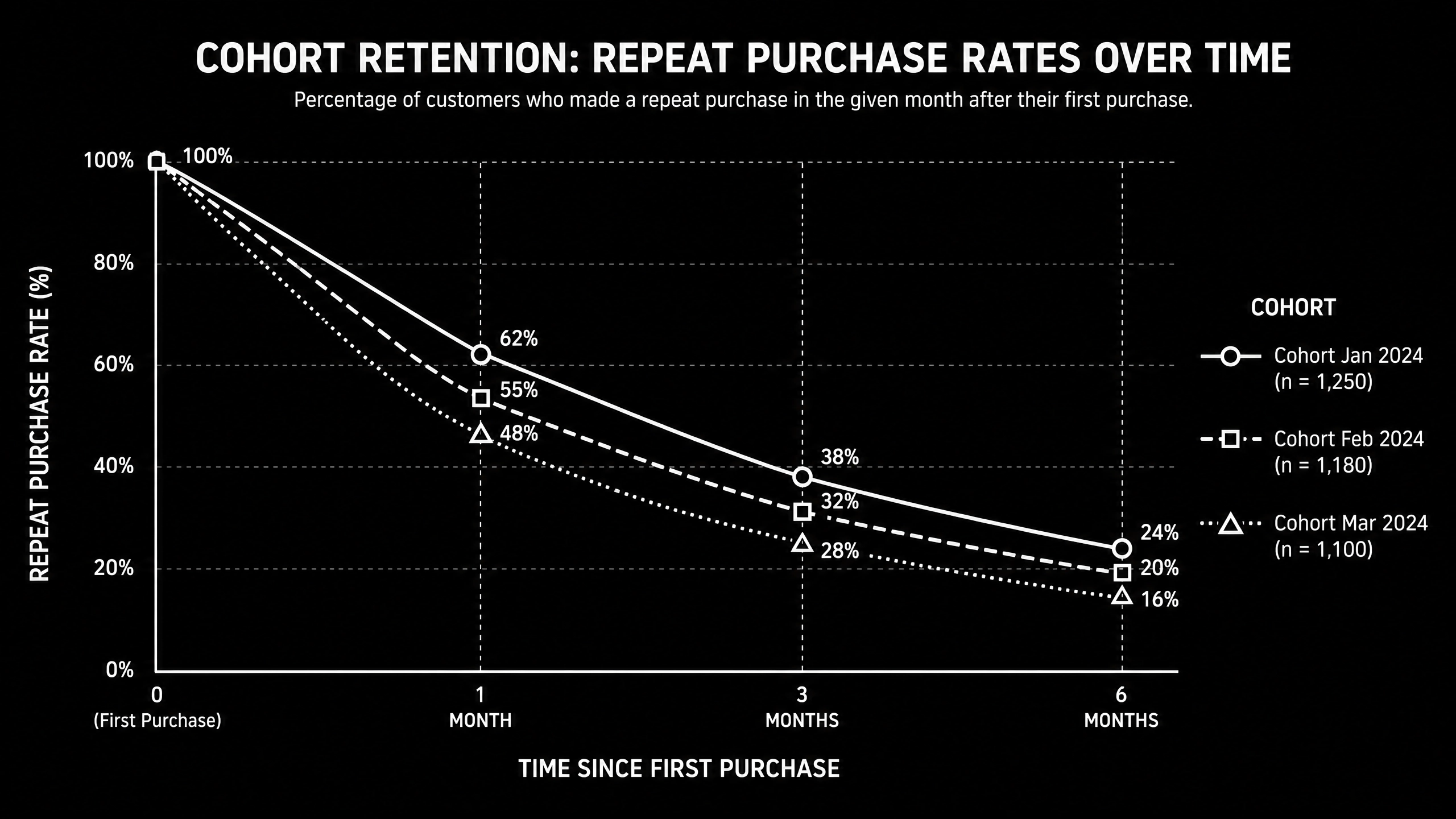
  • Cohort retention tracker
  • Semantic keyword targets to distribute naturally: dtc growth playbook, direct to consumer growth, scaling dtc brand

Use these references during planning and QA: Shopify enterprise resourcesKlaviyo resources, and web.dev ecommerce guidance.

Common Mistakes That Kill Performance

  • Acquisition-only focus
  • Ignoring contribution margin
  • No cross-channel operating rhythm

FAQ – DTC Ecommerce Growth Playbook

How long does a dtc ecommerce growth project usually take?

Most teams can ship an initial version in 4 to 8 weeks, then improve outcomes over one quarter with a weekly optimization cadence.

Is dtc ecommerce growth relevant for UK and US teams?

Yes. The core framework is consistent across both markets. Differences are usually compliance details, buying behavior, and GBP/USD planning.

What should we measure first for dtc ecommerce growth?

Track one leading metric, one conversion metric, and one revenue metric so execution stays tied to business impact.

Should we run this in-house or with a specialist partner?

If your team has deep expertise and bandwidth, in-house can work. If speed and risk control matter, working with a specialist partner is usually faster.

What is the most common failure mode?

Teams skip governance after launch. Data quality drifts, process quality declines, and performance plateaus. A simple weekly operating rhythm prevents this.

Conclusion

DTC Ecommerce Growth Playbook performs best when execution decisions are tied to measurable outcomes from day one. Use this playbook to prioritize what matters, reduce risk, and create a repeatable optimization rhythm.

Want a specialist team to accelerate delivery? Talk to our Shopify developers or book a consultation and we will map a practical rollout plan.

Lead magnet: Download the DTC Growth Lever Map to implement this framework with templates and checklists.

That's enough scrolling for now - chat to a HubSpot expert today!
Contact Us
A/B Testing Framework for SaaS: The 2026 Experiment Engine

A/B Testing Framework for SaaS in 2026 is won by execution quality, not platform hype. Teams that perform consistently align strategy, implementation, and measurement into one operating system. This guide gives the practical framework, internal link map, and optimization cadence to do that.

Most SaaS A/B testing programs run experiments that can’t move the needle. Here’s the framework that ships winners. If you want implementation help, work with talk to our team. For connected strategy, also review Conversion Rate Optimization Playbook and Saas Website Growth Strategy.

What A/B Testing Framework for SaaS Means in Practice

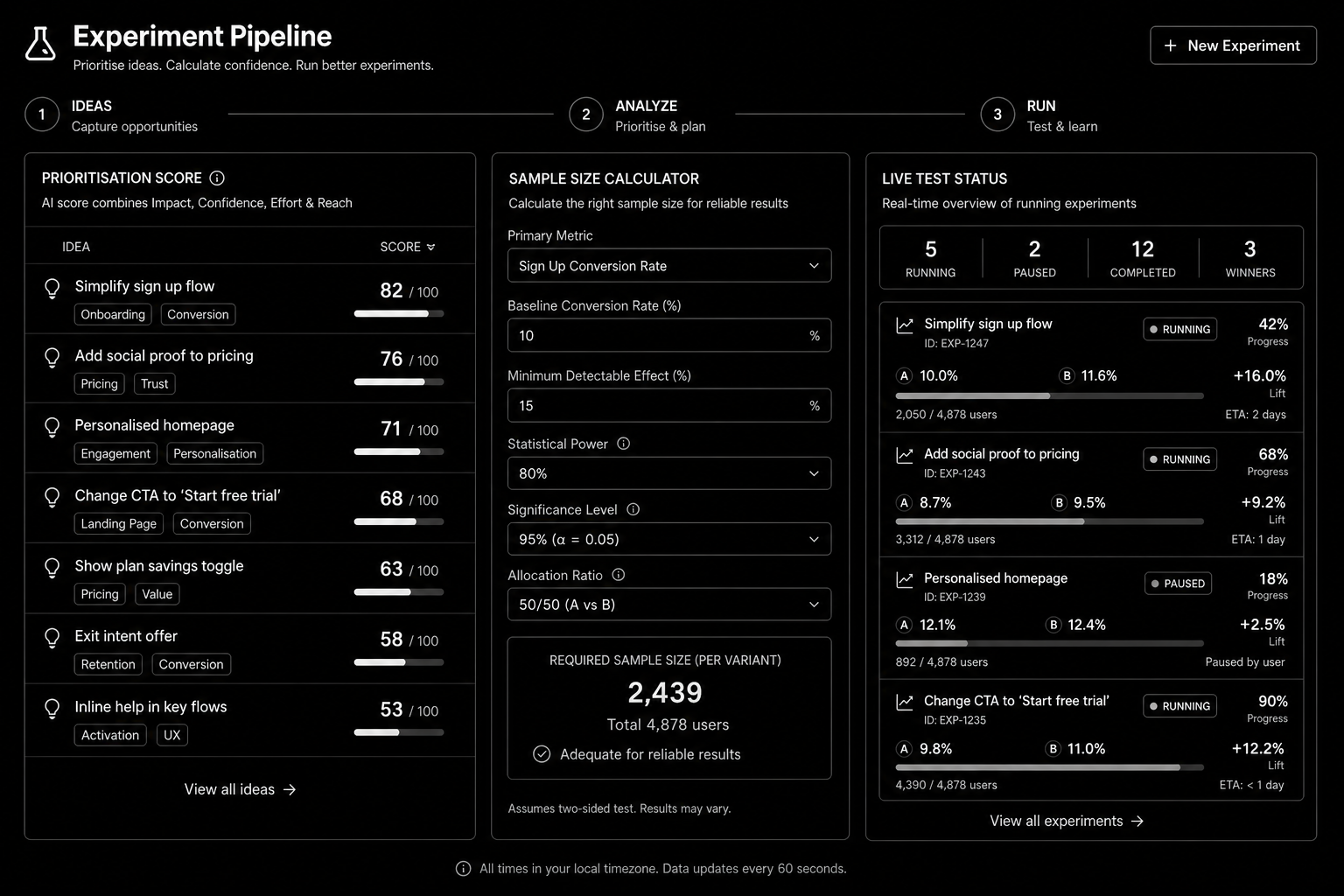
A/B testing for SaaS requires an experiment engine, not ad-hoc tests. Durable gains come from clean instrumentation, strong prioritization, and statistical discipline.

Why a/b testing for saas Matters in 2026

1. Underpowered tests waste traffic and time.

2. Velocity matters only when learning quality remains high.

3. Cross-functional teams need shared experimentation governance.

Step-by-Step Playbook

1. Build experiment backlog

Store ideas with problem statement, KPI, and expected mechanism.

2. Prioritize rigorously

Use ICE or PIE to focus limited traffic on high-upside tests.

3. Set test math upfront

Define sample size, guardrails, and stopping criteria.

4. Run clean operations

Control overlap, seasonality, and tracking integrity.

5. Archive learnings

Document outcomes to avoid repeat failures.

Mid-article CTA -> Need support applying this to your stack? SaaS experimentation audit and get a scoped roadmap with timeline, owners, and KPI targets.

Tools, References, and Benchmarks

  • Experiment brief template
  • Sample size calculator
  • Learning repository framework
  • Semantic keyword targets to distribute naturally: saas split testing, growth experiments saas, experimentation framework

Use these references during planning and QA: Google Analytics HelpOptimizely A/B testing glossary, and web.dev UX guidance.

Common Mistakes That Kill Performance

  • Running underpowered tests
  • Changing goals mid-test
  • Not documenting learnings

FAQ – A/B Testing Framework for SaaS

How long does a a/b testing for saas project usually take?

Most teams can ship an initial version in 4 to 8 weeks, then improve outcomes over one quarter with a weekly optimization cadence.

Is a/b testing for saas relevant for UK and US teams?

Yes. The core framework is consistent across both markets. Differences are usually compliance details, buying behavior, and GBP/USD planning.

What should we measure first for a/b testing for saas?

Track one leading metric, one conversion metric, and one revenue metric so execution stays tied to business impact.

Should we run this in-house or with a specialist partner?

If your team has deep expertise and bandwidth, in-house can work. If speed and risk control matter, working with a specialist partner is usually faster.

What is the most common failure mode?

Teams skip governance after launch. Data quality drifts, process quality declines, and performance plateaus. A simple weekly operating rhythm prevents this.

Conclusion

A/B Testing Framework for SaaS performs best when execution decisions are tied to measurable outcomes from day one. Use this playbook to prioritize what matters, reduce risk, and create a repeatable optimization rhythm.

Want a specialist team to accelerate delivery? Talk to talk to our team or book a consultation and we will map a practical rollout plan.

Lead magnet: Download the SaaS Experiment Backlog Template V2 to implement this framework with templates and checklists.

That's enough scrolling for now - chat to a HubSpot expert today!
Contact Us