
 Website Designing
 Web Development
 Mobile Applications
 Marketing
 CMS & Ecommerce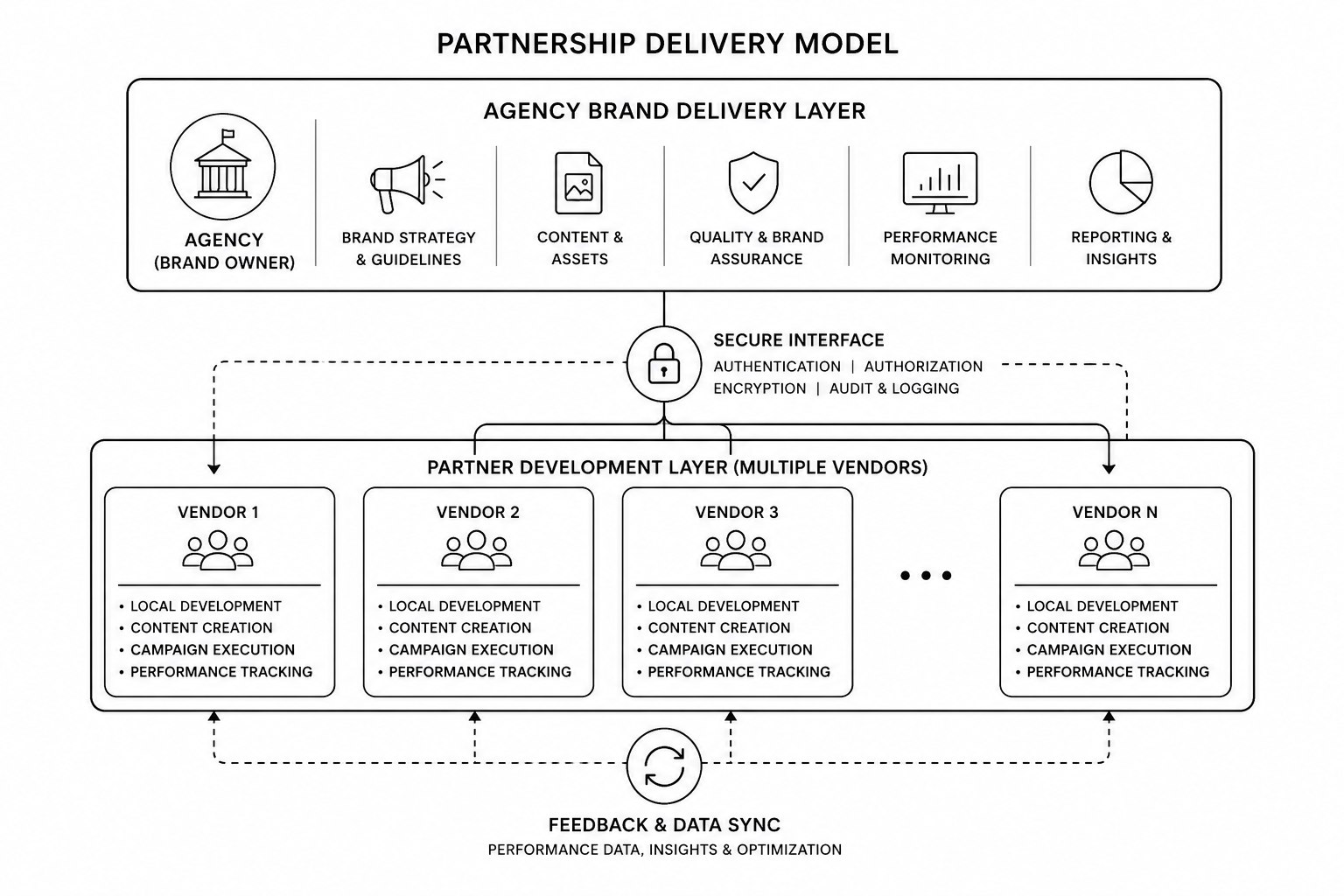
Table of Contents
The agencies scaling fastest in 2026 aren’t the ones hiring the most developers. They’re the ones using white-label partners to deliver 3–4x their internal capacity while maintaining margin and quality.
This guide covers the white-label model, how to implement it without destroying margins or client trust, what to look for in white-label partners, and how to structure partnerships that actually work. Written for agency leaders scaling in a constrained hiring market.
The White-Label Model: Why It Works
Traditional agency: Double your revenue = double your hiring burden. 10 years to scale from £500k to £5M revenue. Hiring, training, management overhead is brutal.
White-label agency: Double your revenue = partner with one white-label firm. Deliver under your brand. 3–4 years to scale from £500k to £5M revenue. Margin stays strong (60–70% net if structured correctly).
White-label lets you:
- Scale revenue without headcount.
- Maintain margin (you still own client relationship, pricing, profit).
- Keep team lean for sales, strategy, account management.
- Test new platforms (Framer, emerging tools) without hiring specialists.
- Serve clients faster without waiting for headcount availability.
The trade-off: Quality depends on partner selection and oversight. Bad white-label partner = your brand damage. Choose carefully.
The Three Models of White Label
Model 1: Partner-Specific (Webflow Agency + Framer Partner)
You’re strong at Webflow. Partner strong at Framer. When client needs Framer, you hand to partner, handle client relationship. Partner delivers, you invoice client. You keep 25–35% markup.
Pros: Simple, clean, specialist partners. Cons: Single-partner dependence, limited to specific platforms.
Model 2: Capacity Partner (Variable Volume)
Same platform specialisation (both Webflow agencies). Partner absorbs overflow work when your team is full. You handle client calls, they handle build. You split margin 50–50 or take 40% markup.
Pros: Flexible capacity, same quality standard. Cons: Requires careful onboarding, quality depends on partner discipline.
Model 3: Fixed Engagement (Retainer Delivery)
You own clients and sales. Partner owns all day-to-day delivery (builds, updates, support) under white label. You charge £X, partner costs £Y, you keep £X–Y profit. Scales infinitely, hardest to execute well.
Pros: Infinite capacity. Cons: Highest quality risk, requires strong systems and oversight.
Choosing a White-Label Partner
Red flags:
- No portfolio or case studies (where’s the proof?)
- Unwilling to sign NDA or IP agreement
- Unwilling to take quality responsibility
- “We can do anything” (specialists beat generalists)
- Unclear communication or slow response time
- Significantly cheaper than your internal cost (usually means corners are cut)
Green flags:
- Deep specialisation (Webflow-only, not “we do everything”)
- References from other agencies they white label for
- Clear QA process and standards documentation
- Willing to sign terms around timeline, quality, and revisions
- Transparent about capacity and availability
- Pricing within 15–30% of your internal cost
Structuring the Engagement: Protect Quality and Margin
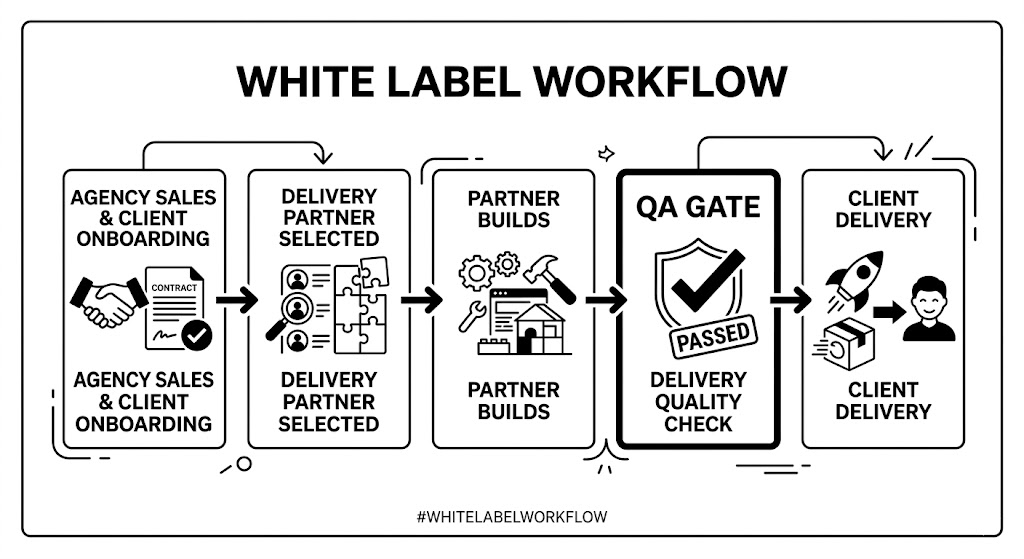
1. Service level agreement (SLA). Explicit timeline, revision count, responsiveness SLA. “Delivery in 8 weeks, 2 rounds of revisions, 24-hour response time” keeps both parties aligned.
2. QA gate before client delivery. Partner delivers to you first. You do QA. Only after approval goes to client. You’re the quality filter.
3. Client relationship stays with you. Partner never talks to client directly. You own all communication. Protects your brand, simplifies escalation.
4. Clear scope definition upfront. Scope creep is the death of white-label margins. Partner builds what was agreed. Anything else is time-and-materials or out of scope.
5. Fixed-price with change order process. Partner quotes fixed. Changes require written change order. Protects both sides.
6. IP and confidentiality agreement. Partner agrees all work product belongs to you. Your client materials stay confidential. Standard legal language.
Margin Math: Keep It Healthy
Your cost: £10,000 build
You charge client: £15,000 (Webflow Agency Model 1) or £20,000 (Capacity Partner Model 2)
Partner cost: £7,000–£8,000
Your profit: £2,000–£5,000 per build (16–50% margin)
If partner cost approaches your delivery cost (£10k), you’re not gaining margin advantage. Renegotiate or find different partner.
Rule of thumb: Partner cost should be 60–75% of what you’d charge client. That keeps margin healthy (25–40%) while staying competitive.
Scaling your agency with white label and want to vet partners? Our Webflow team white labels for agencies across UK and USA. Let’s talk about partnership.
FAQ
Is white label cheaper or more expensive than hiring?
Cheaper long-term if structured right. You avoid hiring, training, benefits, and management overhead. Margin is lower per project but volume is higher. Break-even is usually 6–12 months.
How do I maintain quality with white label?
Strong QA process before client delivery. Clear SLA. Reference checks. Trial project before committing to volume. Never white label your entire business to one partner.
Should I white label 50% of capacity or more?
Start with 20–30%. Prove the partner works. Scale to 40–50% only after three successful projects. Never more than 60% to any single partner (concentration risk).
What if the white-label partner breaks quality?
You find a new partner and transition. This is why you don’t hand off your entire business. Diversify across 2–3 partners if you’re going heavy on white label.
Is it ethical to white label?
Yes, if you’re transparent. Clients don’t care who builds their site as long as it’s built well and on time. White label is normal in agencies.
Conclusion: White Label Is How Small Agencies Become Large
The agencies scaling from £1M to £10M revenue aren’t hiring 20+ people. They’re working with 5–8 internal people and 2–3 white-label partners. Lean, profitable, sustainable.
White label isn’t outsourcing, it’s scaling. Do it right, you compound client relationships and revenue. Do it wrong, you destroy your brand.
Use the framework above. Find good partners. Protect your quality gate. You can 3x revenue in 3–4 years without the hiring nightmare.
Our team white labels Webflow, HubSpot, and Shopify delivery for growing agencies. Let’s talk about partnership.
The White Label Partnership Brief
— template SLA, partner vetting checklist, and margin calculator for white-label engagements.