

Every growing company reaches the same question: should web design stay with an agency or move in-house? The usual answer, "it depends", is true but unhelpful. It depends on a few specific things you can measure: how much design work you have, how steady it is, which skills you need and how quickly you need them.
This guide compares outsourcing and in-house web design on cost, speed, quality and scale, and gives you a simple way to decide which model, or which mix, fits your team.
The three models
- In-house team. Designers and developers on your payroll, working only on your brand.
- Outsourced agency or partner. An external team that delivers projects or ongoing work under a contract.
- Hybrid. A small in-house core (often a design lead or web manager) that owns the brand and roadmap, with an outside partner for build capacity and specialist skills.
Most companies that scale their website well end up hybrid, but the right starting point depends on your situation.
Side-by-side comparison
| Factor | In-house | Outsourced | Hybrid |
|---|---|---|---|
| Cost structure | Fixed salaries, benefits, tools and management time | Variable; pay for projects or a retainer | Small fixed core plus variable build cost |
| Time to start | Months to recruit and onboard | Weeks | Weeks, once the core is in place |
| Brand knowledge | Deep and constant | Builds over time; needs good briefs | Held by the in-house core |
| Skill range | Limited to the people you hire | Broad: design, development, SEO, CRO, QA | Broad, with in-house direction |
| Speed on small changes | Fast | Depends on the retainer and process | Fast for small changes; partner for larger builds |
| Scaling up or down | Slow and costly | Easy | Easy |
| Risk if a person leaves | High | Low; the partner covers | Moderate |
When in-house makes sense
- You have a steady, high volume of design and development work every week.
- The website is your product or your main sales channel, and changes ship daily.
- You can offer designers and developers enough variety and career growth to keep them.
- You have someone who can manage and review technical work.
When outsourcing makes sense
- Work comes in projects: a redesign, a migration, a new product launch.
- You need several skills at once (UX, UI, development, SEO, accessibility) but not full-time.
- You need to move faster than recruiting allows.
- You want experience from many similar projects rather than one person's view.
How to compare the real cost
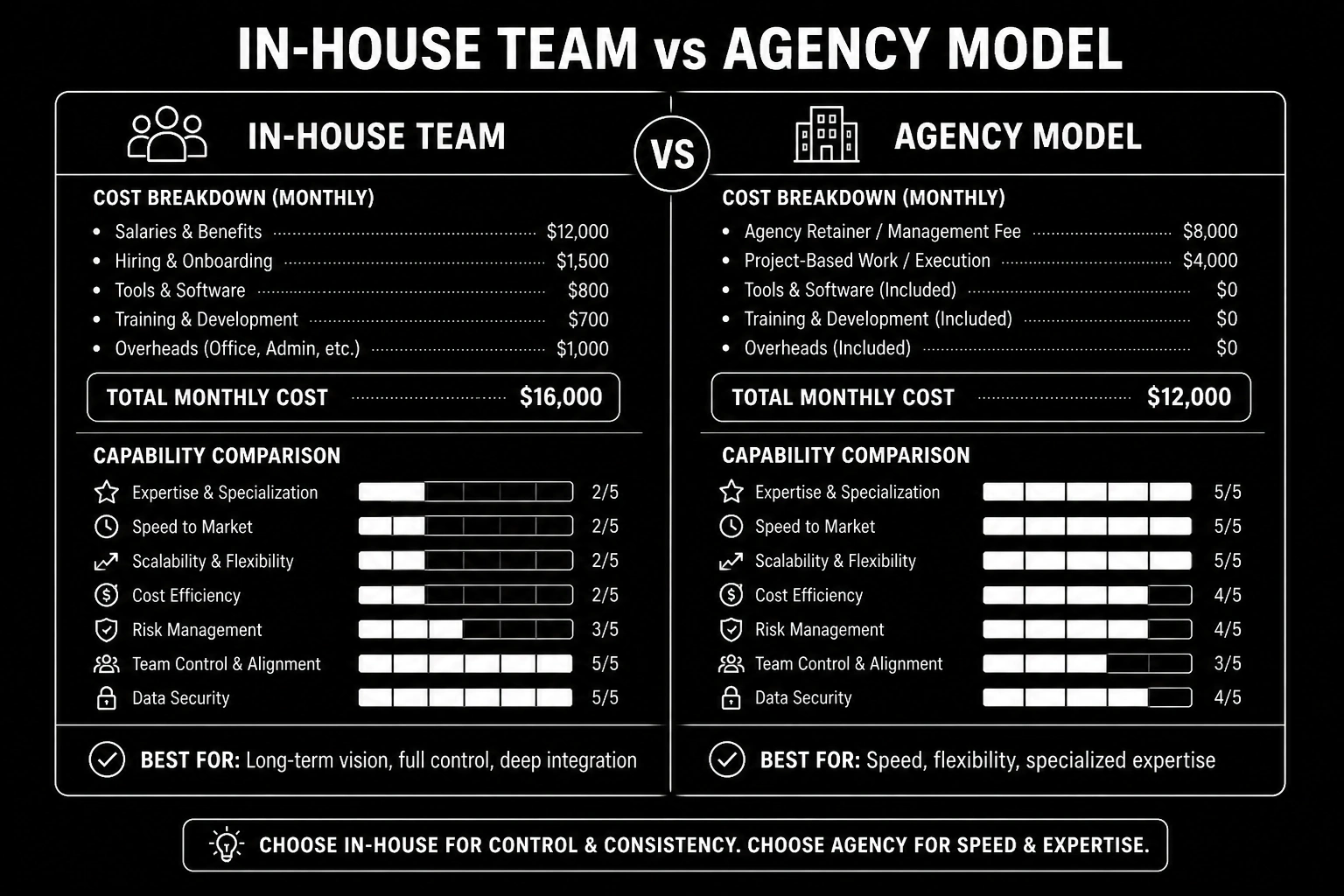
Salary is only part of the in-house cost. Add recruitment, benefits, equipment, software licences, training, management time and the cost of gaps when someone is on leave or leaves. For outsourcing, add your internal time to brief, review and approve work, plus a buffer for changes.
Then compare both against the same 12-month workload. If the in-house team would sit partly idle between projects, outsourcing usually wins. If they would be fully utilised all year, in-house often wins over time. Our website redesign cost guide helps you estimate the project side.
Making outsourcing work
Outsourcing fails when it's treated as "send a brief, get a website". It works when it's run as a partnership:
- One internal owner. A single person who sets priorities, gives feedback and approves work.
- A written brief for every project. Goals, audience, pages, content status, integrations, deadlines and success measures.
- A design system. Shared components and styles so every new page looks consistent, whoever builds it.
- A regular rhythm. Weekly check-ins and milestone demos, not a surprise reveal at the end.
- Clear ownership. Domains, hosting, CMS accounts, design files and code all in your company's name.
- A start with a pilot. One landing page or a small section before a full redesign.
Questions to ask a potential partner
- Can we see sites you built that are still live and maintained?
- Who will actually do the work, and will that change mid-project?
- How do you handle feedback rounds and scope changes?
- What does your QA process cover before handover?
- What happens after launch: support, maintenance and small changes?
Our list of tips for choosing a web development agency goes further.
The hybrid model in practice
A common setup for growing B2B companies is one in-house web or design lead who owns the brand, roadmap and CMS, supported by an external partner on a monthly retainer for builds, development and specialist work. The lead keeps decisions fast and consistent; the partner provides capacity and breadth without adding headcount. Agencies use the same model in reverse, outsourcing builds to a white-label partner while keeping design and client relationships.
FAQ
Is outsourcing web design cheaper than hiring?
Usually, when work is irregular or needs several skills. With steady full-time workloads, in-house can be cheaper over time.
Will an outside team understand our brand?
Yes, if you give them a clear brand guide, design system and an internal owner to give feedback. Brand knowledge builds quickly with a consistent partner.
How do we avoid being locked in to an agency?
Keep every account, file and repository in your company's name, and ask for documentation as part of every project.
Can we start outsourced and move in-house later?
Yes. Many companies outsource the redesign, then hire a web manager to run the site with the partner on a smaller retainer.
Conclusion
Choose the model that matches your workload, not your preference. Steady, daily work favours in-house; project-based, multi-skill work favours outsourcing; most growing teams do best with a small in-house core and a reliable partner. If you're weighing your options, see our web design and website maintenance services, or book a call.
The In-House vs Agency Decision Guide — cost comparison worksheet, capability gap matrix, vendor evaluation scorecard, project governance template, pilot project checklist, 30/60/90-day rollout plan, and decision framework to choose the right web design model for long-term growth.