
 Website Designing
 Web Development
 Mobile Applications
 Marketing
 CMS & Ecommerce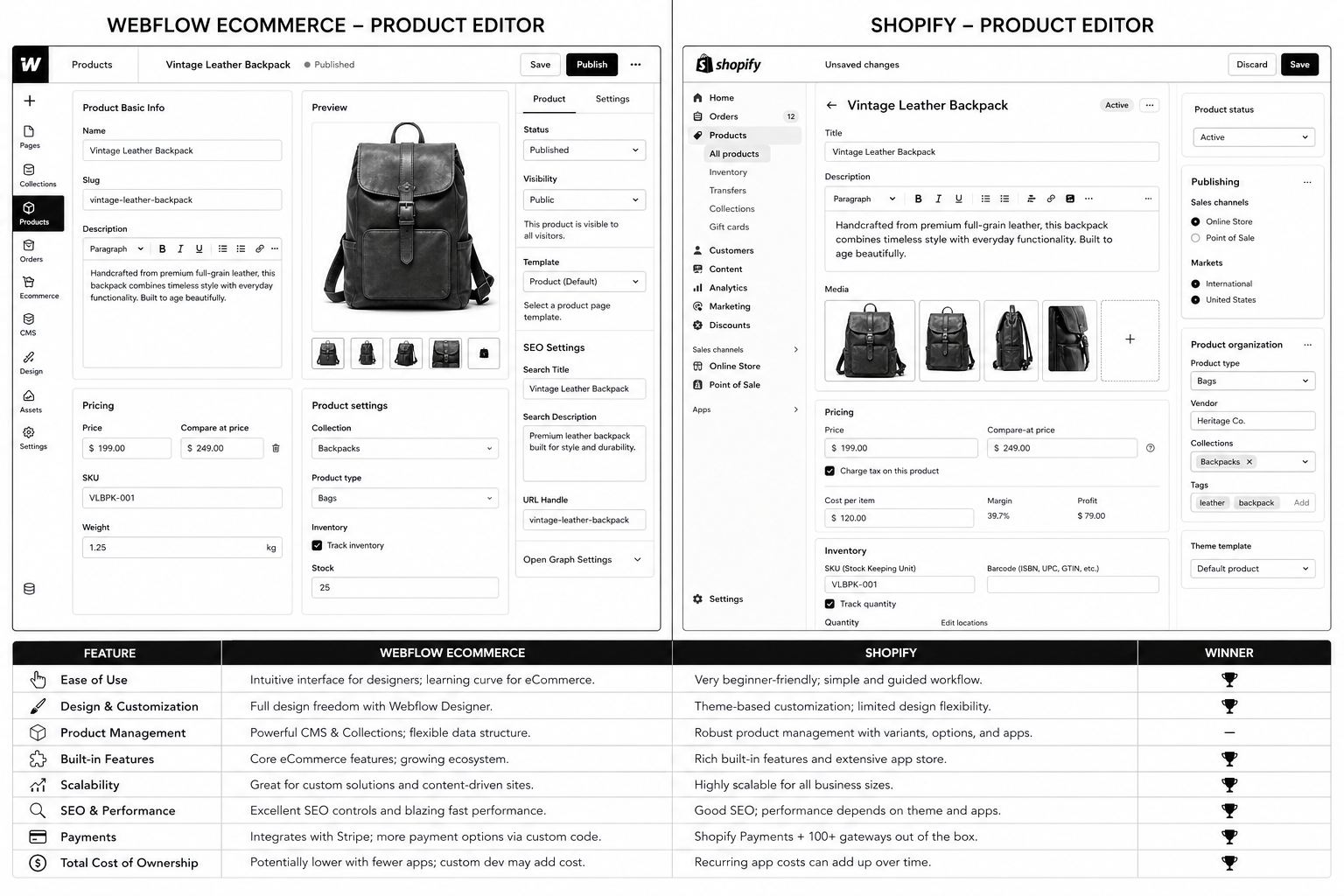
Table of Contents
The Webflow vs Shopify question gets framed as a fight. It isn’t. The two platforms barely overlap on customer profile in 2026 — they just occasionally chase the same SMB lead. The real question for founders and ecommerce leaders is: which one fits the brand you’re actually building?
This Webflow Ecommerce vs Shopify comparison is the honest 2026 breakdown — features, pricing, performance, scalability, and the brand profile each platform serves best. No fence-sitting. By the end you’ll know which one to choose, and why our Webflow agency and Shopify development teams routinely recommend the other one when the fit is wrong.
If you want a broader platform decision, also see the Shopify vs WooCommerce vs BigCommerce comparison.
What Each Platform Actually Is
Shopify is a purpose-built ecommerce platform — store, checkout, payments, inventory, shipping, taxes, apps, fulfilment partners — at every scale from $0 to $1B+ GMV. It’s vertically integrated for selling.
Webflow Ecommerce is the ecommerce module bolted onto Webflow’s design-first CMS. It’s a way for design-led brands to run a small-to-mid commerce operation inside the same site that handles their marketing content.
That difference shapes everything else. Shopify is a commerce platform with marketing features. Webflow is a marketing platform with commerce features.
Why the 2026 Comparison Looks Different from 2022
Three things shifted recently.
1. Shopify’s checkout extensibility is now real. The 2025 Checkout Extensibility GA closed the customisation gap that pushed brands toward custom builds. See our Shopify checkout extensibility guide.
2. Webflow Ecommerce hasn’t kept pace. Multi-currency, advanced subscription models, and serious B2B features remained light. Webflow continues investing in CMS and Logic, not in ecommerce parity.
3. The “design-led DTC” niche stayed loyal to Webflow. Brands selling 20–200 SKUs where the site itself is part of the product experience continue choosing Webflow Ecommerce because Shopify’s design constraints feel limiting.
How They Compare on the Decisions That Matter
Pricing (2026 rates, GBP and USD)
| Tier | Webflow Ecommerce | Shopify |
|---|---|---|
| Entry | $29/mo USD (~£23/mo) – Standard plan, up to 500 items | $39/mo USD (~£25/mo) – Basic Shopify |
| Growth | $74/mo USD (~£59/mo) – Plus plan, 1,000 items | $105/mo USD (~£65/mo) – Shopify |
| Scale | $235/mo USD (~£185/mo) – Advanced plan, 3,000 items | $399/mo USD (~£259/mo) – Advanced Shopify |
| Enterprise | Custom – Webflow Enterprise | $2,300+/mo USD – Shopify Plus |
Headline pricing favours Webflow at lower tiers. App costs change the picture: Shopify stores typically run $100–500/mo in apps. Webflow stores rely less on apps but pay for design and dev work upfront.
Product catalog and inventory
Shopify wins decisively. Native inventory across locations, variants up to 100 per product, multi-location stock, transfers, POS sync. Webflow Ecommerce caps variants and lacks multi-location inventory natively.
If you have more than ~200 SKUs or any multi-location warehousing, Shopify is the answer.
Checkout and payments
Shopify Pay, Shop Pay, native Apple/Google Pay, dozens of regional payment methods, accelerated checkout that lifts conversion 5–15% on returning customers. Webflow’s checkout is functional but plain.
For high-volume DTC, the Shopify checkout alone is worth the platform difference. Conversion rates show it.
Subscriptions and B2B
Shopify has native subscription APIs, a thriving subscription app ecosystem (Recharge, Smartrr, Bold), and native B2B wholesale features (see Shopify B2B wholesale guide). Webflow’s subscription support is essentially DIY via Stripe and Logic.
Design flexibility and brand expression
Webflow wins decisively here. Pixel-perfect control, custom interactions, no theme lock-in, full visual freedom on every page. Shopify’s theme system is more flexible than it was in 2022 (especially with Online Store 2.0 sections), but it still feels like a templating system, not a design canvas.
For brands where the site is part of the brand experience — fashion, design objects, premium DTC, lifestyle — Webflow’s flexibility is hard to give up.
Content marketing and SEO
Webflow is built around CMS. Shopify’s blog is famously weak — most serious Shopify content operations run on Webflow or WordPress and link out to the Shopify store. See our Webflow CMS tutorial for the content architecture.
If content marketing is core to your acquisition strategy, Webflow’s CMS is a real advantage even if you eventually run the store on Shopify.
Apps and ecosystem
Shopify has 8,000+ apps; Webflow has tens. For shipping logistics, advanced reviews, loyalty, analytics, and ops automation, Shopify wins on ecosystem depth.
Performance and Core Web Vitals
Webflow’s defaults beat most Shopify themes on Lighthouse. Modern Shopify themes (Dawn, custom-built) can match Webflow with care. Heavy app stacks tank Shopify CWV unless audited.
Multi-currency, multi-region
Shopify Markets handles multi-currency natively across all plans. Webflow Ecommerce multi-currency is limited and clunkier. For brands selling internationally, Shopify wins.
Mid-article CTA → Not sure which platform fits your brand? Book a free platform consultation — we’ll review your business and recommend the right answer in 30 minutes, no sales pressure.
Step-by-Step: How to Choose Between Webflow Ecommerce and Shopify
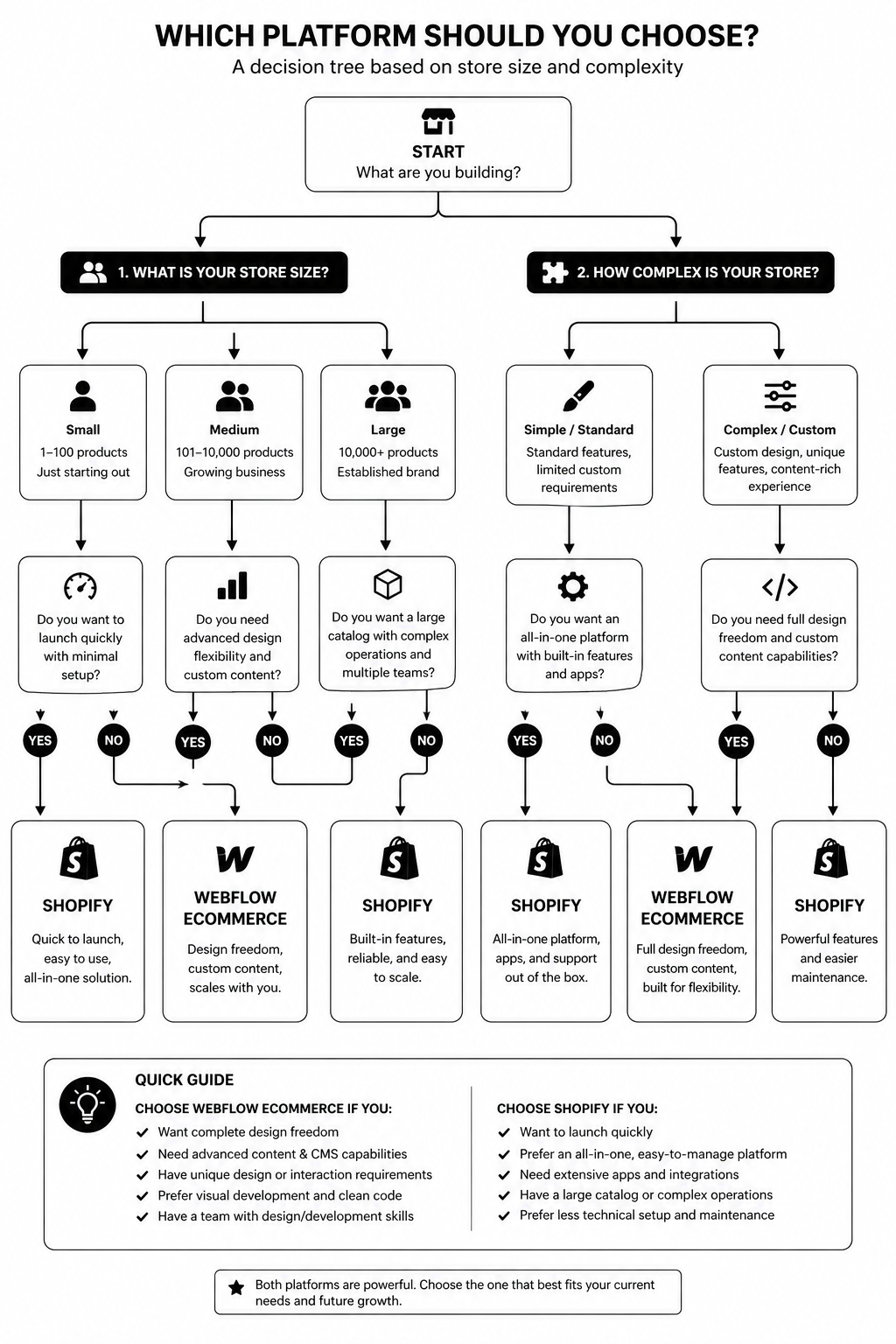
- Count your SKUs and variants. >200 SKUs or complex variants → Shopify. ≤200 simple products → Webflow viable.
- Audit your fulfilment. Multi-location, 3PL integration, POS — Shopify. Single-fulfilment DTC — either works.
- Check international ambitions. Multi-currency / multi-region in next 24 months → Shopify Markets.
- Decide content-marketing priority. SEO and content are #1 acquisition channel → Webflow CMS (with or without Webflow Ecommerce).
- Assess design ambition. Custom interactions, brand-led storytelling sites → Webflow. Standard ecommerce store with minor branding → Shopify.
- Forecast subscription / B2B needs. Either coming in next 18 months → Shopify.
- Sanity-check the team. Marketing-led team that wants visual control → Webflow. Ops-led team that wants integrations → Shopify.
The hybrid play (more common in 2026 than people admit)
Many brands run Webflow for the marketing site and content hub, and Shopify for the store. Subdomain split (`www.brand.com` on Webflow, `shop.brand.com` on Shopify) keeps the design freedom for marketing while giving the commerce side Shopify’s depth.
Done well, this is the best of both. Done badly, you have two platforms to maintain. Worth it for brands above ~$2M GMV with serious content marketing.
Best Use Cases for Each
Webflow Ecommerce wins for
- Design-led DTC brands (20–150 SKUs)
- Premium / niche brands where site is part of the product
- Studios and product brands with strong content marketing
- Membership + light commerce hybrids
- Sites where editorial > transactional
Shopify wins for
- Anything above 200 SKUs
- International / multi-currency stores
- Subscription, B2B, or omnichannel (POS) brands
- Brands scaling past $1M GMV in 12–24 months
- Stores with complex fulfilment or 3PL integration
Common Mistakes When Choosing
- Picking based on monthly subscription cost. Implementation and apps dwarf the plan price. TCO matters.
- Underestimating SKU growth. A brand projecting 50 SKUs ends up at 300 in 18 months. Plan for the trajectory, not the snapshot.
- Choosing Webflow because the designer recommends it. Designer fit and business fit aren’t the same thing.
- Choosing Shopify because the agency only knows Shopify. Same problem in reverse.
- Ignoring the international roadmap. Multi-currency rebuilds are expensive — pick a platform that supports your trajectory.
- Skipping the hybrid option. For content-heavy brands above $2M GMV, hybrid is often the right call.
FAQ — Webflow Ecommerce vs Shopify
Is Webflow Ecommerce good enough for serious brands?
Yes, up to a point. Brands selling 20–150 SKUs in a single market with strong content marketing are well-served. Past that, Shopify becomes the better fit.
Can I migrate from Webflow Ecommerce to Shopify later?
Yes — and many brands do. Product, customer, and order migration tools exist. Plan for SEO redirects on the migration; keep canonical URL structure where possible.
Does Shopify have anything close to Webflow’s design flexibility?
With Online Store 2.0 sections, custom theme development, and now Hydrogen for headless builds — closer than people think. Still not parity. See Shopify Hydrogen guide.
Which platform is better for SEO?
Webflow has the cleaner technical SEO baseline. Shopify caught up but still has known issues (duplicate URLs from collections, blog limitations). For content-driven SEO strategies, Webflow wins.
Are Webflow Ecommerce transaction fees lower than Shopify’s?
Webflow charges 0% transaction fees on Plus and Advanced plans. Shopify charges 0% if you use Shopify Payments, otherwise 0.5%–2% depending on plan. Net cost is similar at scale.
Can I run Webflow for marketing and Shopify for ecommerce?
Yes — and for content-heavy brands above ~$2M GMV, this hybrid is often the right architecture. Subdomain split keeps both platforms doing what they’re best at.
Conclusion: Pick for the Brand You’re Building, Not the One You Have
The honest answer to Webflow Ecommerce vs Shopify: Shopify if commerce is the product, Webflow if the site is part of the product. Above 200 SKUs, international, subscription, or B2B — Shopify, almost always. Design-led DTC under 150 SKUs with content as the growth engine — Webflow.
If you’re between the two and the trade-offs feel close, the hybrid setup is worth a serious look. Our team has shipped both pure-play and hybrid builds for brands across the UK and USA. Book a free platform consultation and we’ll point you at the right answer in 30 minutes.
Download the Ecommerce Platform Decision Matrix V2 — the scoring framework we use on every platform call.